As vertical video consumption accelerates globally, micro-drama is rapidly emerging as one of the most commercially viable formats in digital entertainment. Platforms are no longer asking whether short-form serialized storytelling has demand; the real question is how to structure it for scalability and revenue. This is where technology becomes critical.
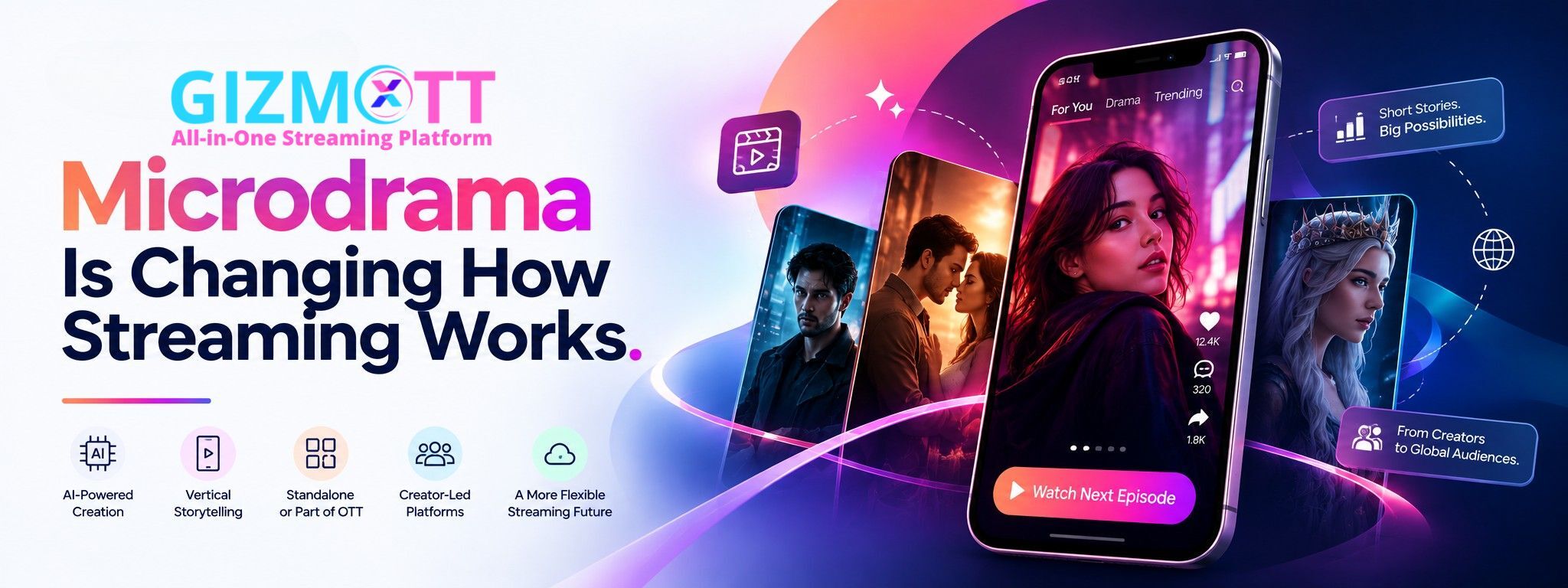
Gizmott, a next-generation OTT platform solution, is positioning itself at the center of this shift by enabling creators, media companies, and rights holders to launch fully customizable micro-drama streaming apps across mobile, web, and connected TV ecosystems. Built to support vertical video streaming, episodic sequencing, and hybrid monetization models such as SVOD, AVOD, and TVOD, Gizmott addresses a growing market need: transforming vertical micro-drama from a social media trend into a structured, revenue-generating OTT business model.
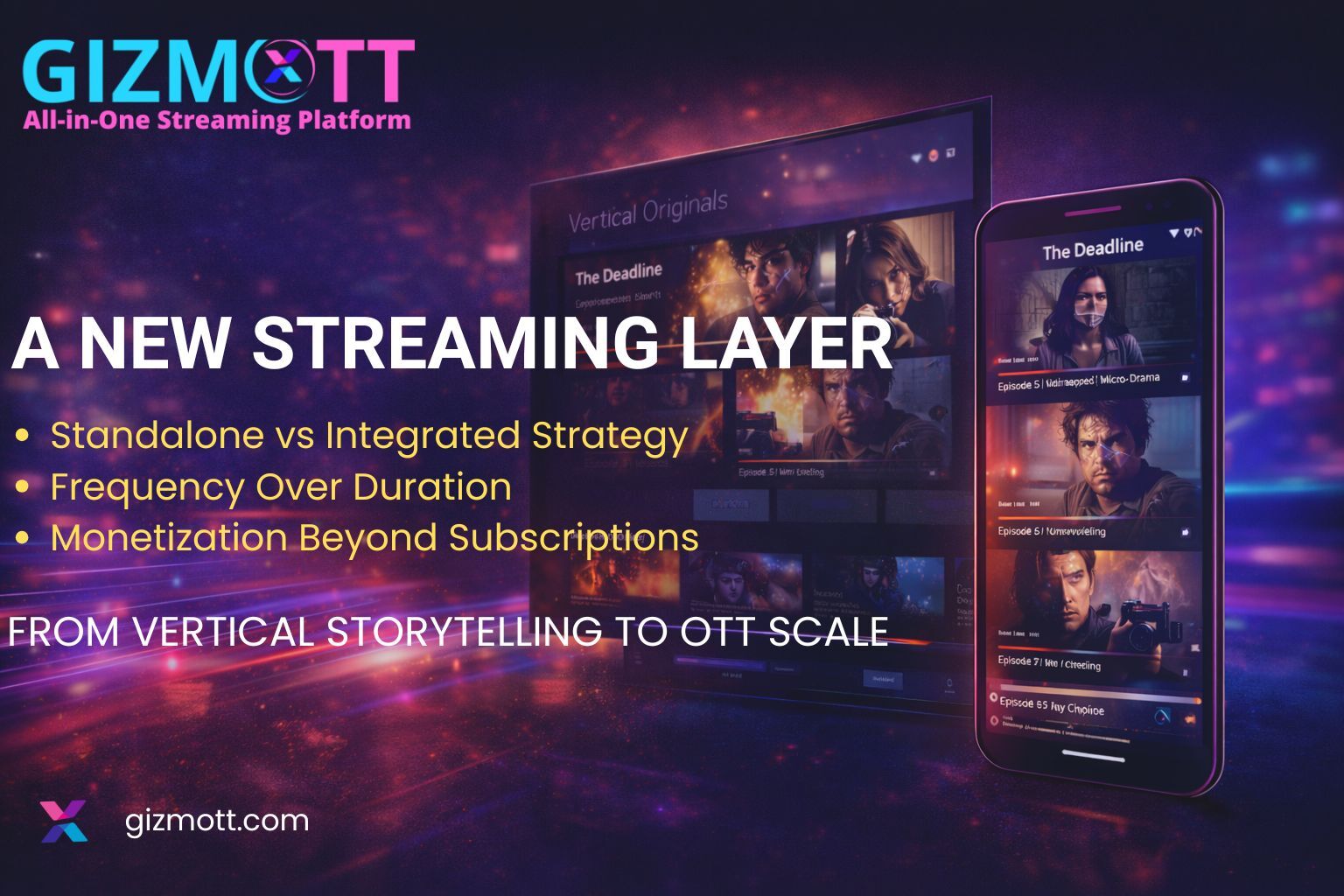
As audience behavior shifts toward mobile-first, on-the-go viewing, the industry must rethink how micro-drama fits into the streaming economy. Can micro-drama stand on its own as a dedicated DTC app? Or does its true power lie in becoming a growth layer within larger OTT platforms?
The answer has implications not just for storytelling but for platform strategy, monetization architecture, and the future of streaming engagement.
What Makes Micro-Drama Different from Short Video?
To understand why this shift matters, it’s important to separate micro-drama from short-form social content. Micro-drama is not just bite-sized video, it is episodic storytelling compressed into seconds or minutes while still retaining the full grammar of drama: character arcs, narrative tension, cliffhangers, emotional payoffs, and serialized progression. What truly differentiates it is not just duration, but consumption rhythm. Traditional OTT platforms optimize for intentional viewing, where users sit down, browse, and commit to a film or episode. Micro-drama, on the other hand, is built for opportunistic viewing fitting seamlessly into commutes, work breaks, in-between tasks, and multi-screen moments.
This fundamentally shifts the engagement equation. Long-form content competes for time; micro-drama competes for frequency and frequency is a powerful metric.
High-frequency engagement leads to:
- Faster discovery cycles
- Shorter feedback loops
- Stronger habit formation
- Greater algorithmic precision
In this model, retention is not about finishing seasons. It is about returning daily. That behavioral shift is why micro-drama cannot be treated as a side category. It requires its own product logic.
Micro-Drama as a Standalone App: A Revenue Engine in Its Own Right
The strongest argument for micro-drama as a standalone app is clarity of purpose.
When users open a dedicated micro-drama platform, there is no ambiguity. They are not choosing between two-hour films and five-minute stories. They are entering a vertical storytelling environment built entirely around rapid narrative progression.
This allows for product optimization around:
- Vertical viewing
- Seamless autoplay
- Ultra-fast startup
- Episode chaining
- Daily return loops
Standalone micro-drama apps often function more like games than traditional streaming platforms. The question is not “What should I watch tonight?” It is “What happens next?”
That distinction is critical for monetization.
Monetization Models for Standalone Micro-Drama Apps
A dedicated micro-drama app unlocks revenue structures that differ from subscription-first OTT:
- Microtransactions and Unlock Models
Users can unlock episodes, arcs, or story bundles. The shorter format reduces psychological friction around small payments.
- Ad-Supported Momentum
Ads can be placed between short episodes without disrupting long narrative immersion. The pacing aligns naturally with episodic breaks.
- Freemium Subscription Layers
Premium users can skip ads, unlock early access, or access exclusive storylines.
- Branded Story Integrations
Brands can integrate into serialized narratives, aligning with emotional peaks rather than interrupting long-form arcs.
Because production cycles are shorter, content testing becomes faster. Platforms can experiment with story concepts, evaluate episode-level retention, and scale only what performs.
For creators, this reduces risk. For platforms, it reduces capital intensity.
Most importantly, a standalone micro-drama app can generate revenue independently not as a secondary format, but as a primary product category.
The Case for Micro-Drama Inside OTT Platforms
If standalone micro-drama apps thrive on focus and behavioral precision, OTT platforms thrive on ecosystem leverage. Established streaming platforms already possess scale – subscriber bases, content libraries, brand recognition, and monetization infrastructure. The strategic opportunity, therefore, is not to replicate what standalone apps do, but to integrate micro-drama in a way that amplifies existing strengths.
Embedding micro-drama within an existing OTT platform provides strategic advantages:
- Re-engaging dormant users
- Creating low-commitment entry points
- Extending intellectual property across formats
Attracting mobile-first audiences
In this model, micro-drama functions as both an acquisition and retention layer. Imagine a user opening an OTT app unsure of what to watch. Instead of scrolling endlessly through feature films and hour-long episodes, they encounter a short serialized story that requires only two minutes of commitment. That small, immediate entry point reduces decision fatigue, increases session starts, and gradually builds platform stickiness. Over time, these micro-engagements can translate into deeper content exploration and stronger overall retention.
Micro-drama inside OTT can function as:
- A discovery accelerator
- A testing ground for new IP
- A mobile-first engagement surface
A bridge between short sessions and long sessions
For platforms with established subscription bases, this format increases session frequency without cannibalizing long-form viewing. It becomes additive rather than competitive.
Standalone vs OTT Integration: It’s About Infrastructure
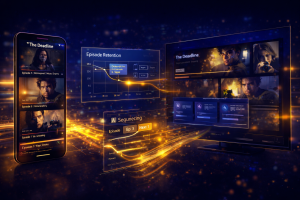 The debate is not purely creative. It is technological.
Supporting micro-drama whether standalone or embedded requires infrastructure capable of:
The debate is not purely creative. It is technological.
Supporting micro-drama whether standalone or embedded requires infrastructure capable of:
- Rapid episode sequencing
- Personalized ordering
- Real-time performance analytics
- Flexible monetization frameworks
Low-latency playback
Traditional OTT systems are built around catalogs and seasons. Micro-drama platforms are built around flows and loops. Metrics also change.
Instead of focusing on season completion rate and average watch time, platforms must analyse:
- Episode-level drop-off
- Return frequency
- Narrative velocity
Engagement density
This requires a shift in data interpretation.
Drop-off is not always a failure, it can be a signal. If a viewer leaves after episode three, the question becomes why that exact moment lost momentum.
Standalone apps have the advantage of building this logic natively. OTT platforms must adapt their existing systems to support it without creating product friction.
The Behavioral Economics of Micro-Drama
One of the strongest SEO and industry search terms today is “mobile-first streaming.” Micro-drama embodies that shift.
Smartphone consumption has changed narrative tolerance. Viewers are comfortable with shorter bursts but expect immediate payoff. Hooks must appear instantly. Emotional stakes must escalate quickly.
This compression demands new storytelling grammar:
- Modular narratives instead of slow exposition
- Immediate conflict
- High cliffhanger density
Clear episodic cadence
From a business standpoint, this compression increases content throughput. More episodes mean more monetization touchpoints. More touchpoints mean greater revenue optionality. Whether through advertising, subscriptions, or hybrid monetization models, micro-drama expands revenue surfaces.
Why Micro-Drama Is Not Cannibalizing Long-Form Content
A common concern among OTT platforms is cannibalization. Will short-form serialized content reduce time spent on long-form originals? Evidence suggests otherwise.
Micro-drama often functions as:
- A top-of-funnel engagement layer
- A daily touchpoint between premium releases
A discovery gateway for larger IP
It occupies time slots that long-form cannot efficiently capture waiting periods, commute windows, idle moments.
Rather than replacing premium series, micro-drama complements them by increasing overall platform frequency.
In fact, platforms that integrate micro-drama strategically may see improved long-form performance due to higher overall engagement.
Global Opportunity and Localization at Speed
Another critical advantage of micro-drama lies in scalability.
Shorter production cycles allow:
- Faster international adaptation
- Rapid localization
- Cultural experimentation
Audience-driven iteration
Standalone apps can expand into new markets quickly. OTT platforms can test regional narratives without committing to full-scale productions.
Because episodes are short, dubbing and subtitling become less capital-intensive. This accelerates global expansion.
In emerging markets—where mobile consumption outpaces TV viewing—micro-drama may become the dominant storytelling format.
Advertising and Brand Integration: A New Creative Canvas
For advertisers, micro-drama represents an opportunity to rethink integration.
Traditional pre-roll and mid-roll placements often disrupt long-form immersion. Micro-drama’s episodic cadence allows for:
- Narrative-aligned ad placements
- Emotional peak sponsorships
- Contextual brand storytelling
Short branded arcs within series
Advertisers benefit from higher frequency and tighter audience targeting.
Standalone apps can build monetization around episode chains. OTT platforms can leverage existing ad tech stacks to incorporate micro-drama into programmatic ecosystems.
Either way, the revenue potential is significant.
The Strategic Decision: Product or Feature?
Ultimately, the real question is this:
Is micro-drama a product category—or a feature within streaming ecosystems?
If treated as a minor content addition, it risks underperformance. The UX, analytics, and monetization must align with its rhythm.
Platforms that build dedicated micro-drama apps can create entirely new revenue verticals and capture mobile-native audiences. Platforms that integrate micro-drama intelligently into OTT environments can enhance retention and frequency without fragmenting their brand.
The winning strategy depends on organizational maturity, infrastructure capability, and audience profile.
But ignoring micro-drama is no longer an option.
Powering the Decision: Gizmott’s Vertical Micro-Drama OTT Platform Infrastructure
Whether micro-drama becomes a standalone product category or an integrated OTT feature ultimately depends on one critical factor: infrastructure readiness. Launching and scaling vertical micro-drama requires more than content—it demands a purpose-built OTT platform capable of supporting mobile-first streaming behavior, episodic sequencing, and hybrid monetization models.
Gizmott’s vertical micro-drama OTT platform is designed specifically to address this emerging market need. As an end-to-end OTT solution provider, Gizmott enables creators, media brands, and enterprises to launch fully customized micro-drama apps while also supporting seamless integration within existing OTT ecosystems.
For organizations pursuing micro-drama app development as a standalone DTC strategy, Gizmott provides:
- Native vertical video streaming support
- Rapid episode sequencing and autoplay logic
- AI-powered content personalization
- Real-time performance analytics
- Flexible monetization models including SVOD, AVOD, TVOD, and hybrid revenue structures
- Multi-platform deployment across iOS, Android, Web, and Connected TV
For platforms looking to embed vertical storytelling inside their OTT infrastructure, Gizmott enables:
- Integration of micro-drama categories within existing OTT libraries
- Mobile-first engagement layers without disrupting brand architecture
- Episode-level retention tracking and frequency analysis
- Scalable backend systems optimized for high-volume, short-form episodic content
In a market increasingly searching for
vertical OTT platform solutions and
micro-drama streaming app development, the ability to support both standalone and integrated deployment models becomes a competitive advantage. Gizmott further strengthens this capability through
AI-driven features such as AI subtitling and multilingual caption generation for global reach, intelligent content tagging and metadata optimization for improved discoverability, and advanced recommendation engines that adapt to viewer behavior in real time. These AI-powered tools enhance accessibility, accelerate localization, and improve engagement density critical success factors for micro-drama at scale.
The Bigger Shift: From Libraries to Loops
Streaming began as digital shelving—vast libraries waiting to be chosen.
Micro-drama signals a move toward loops—continuous narrative flows that reduce decision friction and increase return frequency.
This is not about shorter attention spans. It is about adaptive storytelling.
In a world of constant distraction, stories must fit into life as it happens.
Platforms that understand this shift will design systems around momentum, not duration. They will measure engagement density rather than total hours. They will build monetization models around frequency rather than patience.
Final Perspective
Micro-drama is not competing with long-form storytelling. It is redefining the entry point.
It can stand alone as a high-frequency, revenue-generating app optimized for mobile behavior. It can also thrive as an embedded OTT layer that increases engagement, discovery, and monetization. Solutions like Gizmott demonstrate how technology can support both strategies enabling creators and media companies to launch standalone micro-drama apps or seamlessly integrate vertical episodic content into broader OTT platforms without compromising user experience or revenue potential.
The core insight is simple:
Micro-drama is not short TV. It is a new serialized experience engineered for the on-the-go era.
The platforms that treat it as such whether standalone or integrated—will shape the next decade of streaming.
Because the future of entertainment does not belong to the longest story.
It belongs to the story that fits.