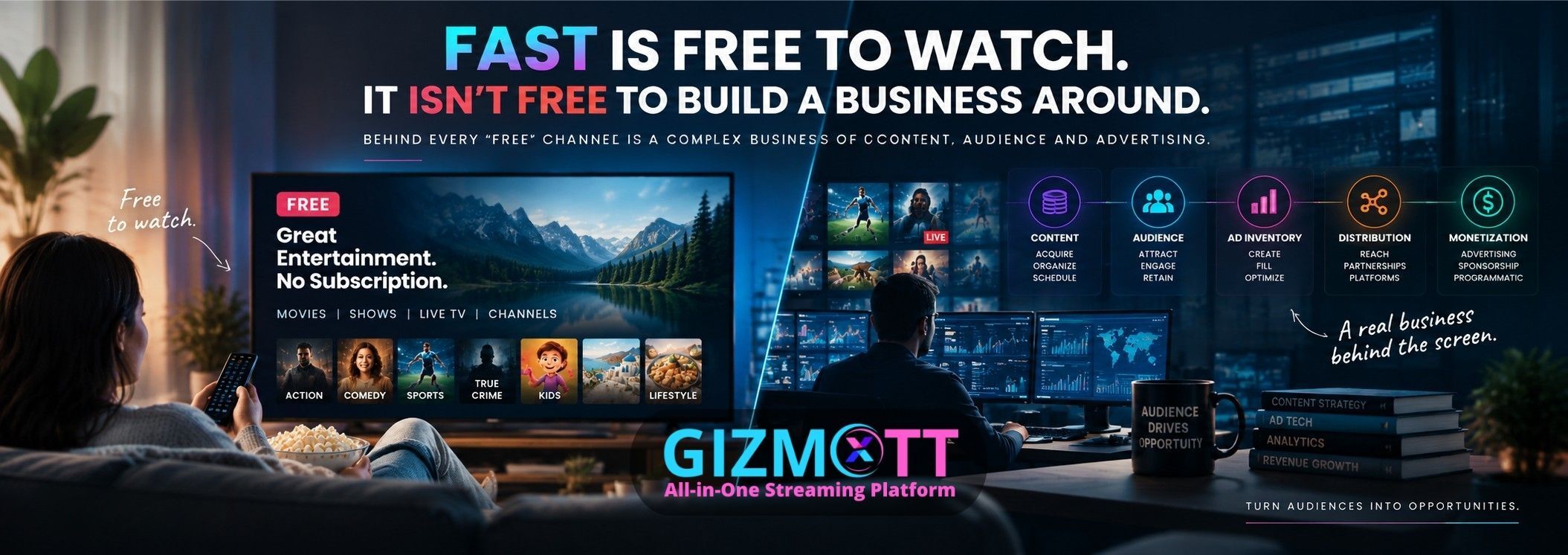

Free for the Viewer Doesn’t Mean Free for the Operator
The fundamental FAST proposition is simple: remove the subscription paywall and monetize viewing through advertising. But removing the paywall does not remove the cost of creating, acquiring, managing, distributing and monetizing the programming. A FAST operation still needs content rights, metadata, scheduling, channel management, streaming infrastructure, ad insertion, distribution, analytics, audience development and commercial relationships. Once a channel reaches meaningful scale, those components stop being technical details and become part of the economics of the business. This is why the most important FAST question is not simply “How do we launch a channel?” It is: “How do we turn every hour of viewing into a valuable commercial opportunity?” That changes the way operators should think about FAST. A viewer is not simply a viewer. That viewer creates watch time. Watch time creates impressions. Impressions create inventory. Inventory creates demand. Demand creates revenue. And the efficiency of that entire chain determines whether a FAST channel is actually a business.A FAST Channel Doesn’t Make Money Just Because People Watch It
One of the easiest mistakes in FAST strategy is treating audience growth as the finish line. It isn’t. A channel can accumulate viewers and still struggle commercially if its inventory is poorly targeted, its fill rate is weak, its advertising technology is inefficient or its audience is difficult to monetize. The economics are more accurately represented as: Audience → Watch Time → Ad Inventory → Demand → Fill → Yield → Revenue Every stage matters. A channel with strong content but poor ad infrastructure leaves money on the table. A channel with sophisticated advertising technology but weak programming has limited inventory worth selling. A channel with high viewing but an undefined audience may struggle to command premium advertising demand. This is where the distinction between FAST channel revenue and FAST business strategy becomes important. The mechanics of CPMs, fill rates, advertising inventory and revenue are important, but they are downstream of a much bigger decision: what kind of audience is the channel being built to attract? That is why FAST should not be treated simply as another distribution format. It is a business model built around audience attention. And that is where the economics become interesting.Your Content Library Is More Than a Library
For many media companies, the FAST opportunity begins with an asset they already own: a substantial content library. Movies, television series, documentaries, sports programming, lifestyle shows, news, archive content and niche programming can potentially be reorganized into continuous linear experiences. The important shift is from thinking about content as something that is simply stored to thinking about it as something that can be continuously programmed and monetized. A library can become multiple businesses at once. The same underlying content can support a VOD service, a FAST channel, short-form clips, a mobile experience, social distribution and potentially a subscription or transactional offering. FAST therefore creates an interesting economic opportunity: increase the number of ways an existing content asset can generate value. This is particularly powerful for companies with large libraries that are not necessarily being consumed consistently through traditional VOD interfaces. Instead of waiting for a viewer to search for a title, the operator can package the content into an always-on viewing experience. The content is no longer simply waiting to be discovered. It is programming the audience’s next viewing session.More Channels Don’t Automatically Mean More Revenue
There is another assumption the FAST industry needs to challenge: if one channel works, more channels must be better. Not necessarily. More channels can mean more inventory, but they can also mean fragmented audiences, duplicated programming, operational complexity and weaker channel identities. The goal should not be to create the largest possible channel portfolio. It should be to create valuable viewing environments. A focused true-crime audience may be commercially more attractive than a broad entertainment audience. A highly engaged sports audience may create more advertising value than a much larger but passive audience. A niche lifestyle channel can become attractive when advertisers know exactly who is watching and why. This is one reason successful FAST ecosystems have increasingly leaned into recognizable programming identities. Tubi has built scale around a broad free streaming proposition while maintaining strong genre and content discovery. Pluto TV built its identity around the familiar lean-back experience of linear television, but delivered through a digital environment. Samsung TV Plus benefits from being embedded directly within Samsung’s device ecosystem; Samsung reported more than 100 million monthly active users globally at the beginning of 2026, with streaming hours up 25% year over year. (Samsung Global Newsroom) These businesses are very different, but they illustrate the same principle: distribution scale works when it is connected to repeatable viewing behavior. FAST isn’t simply about having channels available. It is about creating reasons to keep watching.The Real Product Isn’t the Channel. It’s the Audience.
This is perhaps the most important strategic shift for FAST operators. The channel is the container. The audience is the asset. A successful FAST strategy starts by understanding who the channel is for and then building programming, scheduling, distribution and advertising around that audience. That could mean a channel dedicated to classic films, true crime, sports, business news, food, travel, regional entertainment, faith-based programming, children’s content or a highly specific fandom. The more clearly the audience is defined, the easier it becomes to answer critical commercial questions:- What programming should run at what time?
- Which content drives the longest viewing sessions?
- Which viewers return most frequently?
- Which audience segments are most valuable to advertisers?
- Which programming generates the strongest ad engagement?
- Which channels deserve additional investment?
- Which content should remain exclusive to VOD or subscription products?
Advertising Is Where the Economics Get Complicated
Advertising is the engine behind FAST, but simply adding ads to a stream is not enough. The commercial challenge is making the advertising experience valuable to both the viewer and the advertiser. That means the technology underneath the channel matters. Server-side ad insertion, dynamic ad insertion, SCTE-35 signaling, programmatic demand, campaign management, audience targeting and measurement all contribute to how effectively a FAST operation converts viewing into revenue. Distribution also matters. A FAST channel may live on a publisher’s own application, website and connected-TV ecosystem while also being distributed through major FAST destinations and virtual MVPDs. The trade-off is often between reach, control, audience ownership and economics. The strategic question therefore isn’t simply: “Where can we distribute this channel?” It is: “Which combination of distribution creates the best long-term economics?” That might mean maximizing reach through third-party platforms while using a branded app to retain a direct relationship with the audience. It might mean using FAST as the discovery layer and VOD as the deeper engagement layer. The strongest businesses will increasingly treat distribution as a portfolio decision rather than a single-platform decision.Programmatic Advertising Doesn’t Magically Fix FAST Monetization
Programmatic advertising can increase access to demand, but it doesn’t automatically make a weak channel profitable. If the audience isn’t valuable, the programming doesn’t retain viewers, the inventory isn’t properly structured or the ad experience is poor, adding more demand sources doesn’t solve the underlying problem. The technology has to work as part of a larger system. A commercially effective FAST operation needs to connect: Content strategy → Audience development → Scheduling → Inventory creation → Ad insertion → Demand → Targeting → Measurement → Optimization That is why ad technology is becoming increasingly important to FAST economics. The objective isn’t simply to show more ads. It is to create better monetizable inventory without damaging the viewing experience. That distinction becomes particularly important as FAST competes for advertising budgets against traditional television, CTV platforms and other digital video environments.The Best FAST Strategy May Not End With FAST
There is another reason FAST is strategically interesting for media companies: it doesn’t have to operate as a standalone business. FAST can become the front door to a broader streaming ecosystem. A viewer might discover a brand through a free channel, watch a few programs, move into the company’s VOD library, register for an account, purchase premium content or eventually become a subscriber. That makes FAST more than an advertising product. It can become an audience acquisition channel. This is where the relationship between FAST and VOD becomes particularly powerful. Instead of forcing every viewer into the same monetization model, an operator can allow the audience to move between free, ad-supported, transactional and subscription experiences according to their level of intent.- Someone who casually discovers a channel may remain an ad-supported viewer.
- Someone who becomes deeply engaged with the content may become a subscriber.
- Someone who wants a particular live event may become a PPV customer.
What Successful FAST Businesses Understand
The strongest FAST businesses tend to share a few characteristics, even when their strategies and audiences are very different. They understand that:- Content identity matters. A channel needs a clear reason for existing rather than simply being a random playlist of available titles.
- Audience definition matters. Knowing who watches is fundamental to programming, advertising and distribution decisions.
- Watch time matters more than raw reach. A viewer who returns frequently creates more commercial value than someone who arrives once.
- Distribution matters. A great channel that nobody discovers has limited economics.
- Advertising technology matters. Efficient ad insertion, targeting and demand management directly affect monetization.
- Data matters. Audience intelligence should influence both programming and commercial strategy.
- Multiple revenue paths matter. FAST can feed VOD, subscriptions, PPV, sponsorship and other monetization models.
So What Does a Profitable FAST Business Actually Look Like?
There is no universal formula because FAST economics depend heavily on content rights, audience size, distribution, geography, advertising demand and programming strategy. But the underlying model is increasingly clear. A profitable FAST operation needs to align five things:- Valuable content The programming needs to give viewers a reason to stay.
- A defined audience The channel should know who it is serving and why that audience matters.
- Consistent viewing Recurring watch time creates recurring advertising inventory.
- Efficient monetization infrastructure Ad insertion, programmatic demand, campaign management and measurement need to work together.
- Intelligent optimization Analytics should continuously inform scheduling, content selection, distribution and monetization.
Where GIZMOTT Fits
This is exactly where the technology layer becomes important. GIZMOTT, Gizmeon’s flagship OTT platform, is designed to connect FAST operations with the broader streaming business rather than treating a FAST channel as an isolated product. The platform supports FAST channel management with EPG scheduling, SCTE-35 marker support, SSAI and DAI, while also supporting distribution across major connected-TV environments and vMVPDs. Its analytics layer provides visibility into viewership, engagement, audience behavior and advertising performance. More importantly, the platform can connect FAST with VOD, live streaming, subscriptions and other monetization models from the same technology environment. That allows media companies to build a broader audience strategy rather than operating separate systems for every part of the business. For organizations that want greater infrastructure control, GIZMOTT also supports SaaS and own-and-operate approaches, including deployment within a customer’s cloud environment. = That flexibility matters because the future of FAST will not look identical for every media company.- A creator may want a branded FAST channel connected to a growing community.
- A broadcaster may want to turn its archive into multiple linear channels.
- A content owner may want FAST to become an audience acquisition layer for its VOD business.