
Roku vs Fire TV vs Apple TV: What Actually Makes Them Different?
There is still a legitimate reason consumers search for Roku vs Fire Stick vs Apple TV comparisons. Each platform creates a different viewing environment, and the differences can influence how audiences discover and interact with streaming services. Roku is strongly associated with a simple TV-first experience and a broad streaming ecosystem. Amazon Fire TV sits within Amazon’s wider ecosystem and connects streaming with Alexa, apps and other Amazon services. Apple TV is closely integrated with Apple’s hardware and software ecosystem and tends to appeal to audiences already invested in Apple products. For viewers, those differences matter. For OTT businesses, however, they should lead to a different conclusion.| Platform | What it means for viewers | What it means for OTT businesses |
| Roku | Simple, TV-focused streaming experience | Important connected-TV distribution channel |
| Amazon Fire TV | Streaming integrated with Amazon ecosystem | Major opportunity for reach and app distribution |
| Apple TV | Premium hardware and Apple ecosystem | Important audience segment and premium TV environment |
| Android TV | Broad smart-TV and device ecosystem | Wider connected-TV reach |
| Samsung Tizen | Samsung Smart TV environment | Direct access to a major smart-TV ecosystem |
| LG webOS | LG Smart TV ecosystem | Additional connected-TV distribution |
| Vizio SmartCast | Smart TV viewing environment | Expands CTV reach across another platform |
| Web + Mobile | Flexible access across devices | Discovery, conversion and viewing beyond the TV |
The Problem With Asking Which Streaming Device Is Best
The “best streaming device” is a useful consumer question because consumers generally buy one device at a time. A media company does not have that luxury. If an OTT service decides to support only one connected TV platform, it is effectively making a decision about which part of its potential audience it is willing to serve. That may be reasonable for a very specialized product, but for a growing streaming business it can become a distribution constraint. This is especially important because the OTT business model is no longer based simply on delivering video. A modern streaming service may depend on subscriptions, advertising, transactional purchases, FAST channels, audience analytics, personalization, content discovery and direct relationships with viewers. Every additional screen can therefore represent more than another place to play a video. It can become another point of acquisition, engagement and monetization. The question shifts from “Which device should we build for?” to “How many places should our audience be able to find us?”Your Audience Doesn’t Live on One Screen
The biggest mistake in OTT strategy is treating television, mobile and web as separate audiences. They are usually the same audience behaving differently. A sports viewer might watch a live game on a connected TV, check highlights on a phone and later watch an interview through a web browser. A creator’s audience might discover a vertical video on mobile and eventually subscribe to the creator’s long-form streaming service on a television. That means the streaming platform needs to follow the viewer rather than forcing the viewer to follow the platform. This is where a multi-device OTT platform becomes strategically important. The objective is not simply to launch an app on Roku, Fire TV or Apple TV. The objective is to create a consistent streaming business across the entire device ecosystem while allowing each platform to provide an experience appropriate to the screen. That distinction matters.Connected TV Is More Complicated Than Building One TV App
It is tempting to think that once a streaming application has been developed for one television platform, the same application can simply be copied everywhere. In reality, connected TV development involves platform-specific requirements, user interfaces, remote-control navigation, certification processes, operating-system updates and technical maintenance. Samsung, for example, provides a dedicated development environment for TV applications, including platform-specific APIs, testing and certification requirements. Samsung’s developer guidance also emphasizes remote-control interaction and TV-specific interface design. That is why OTT app development is not simply a matter of resizing a mobile application for a television. A good connected TV experience has to feel native to the device. The navigation needs to work naturally with a remote. The interface needs to make sense from several feet away. Performance needs to be reliable on the target hardware. Updates need to account for changing operating systems and platform requirements. And all of this needs to happen while maintaining a consistent brand experience.Samsung Tizen and Vizio Change the Conversation
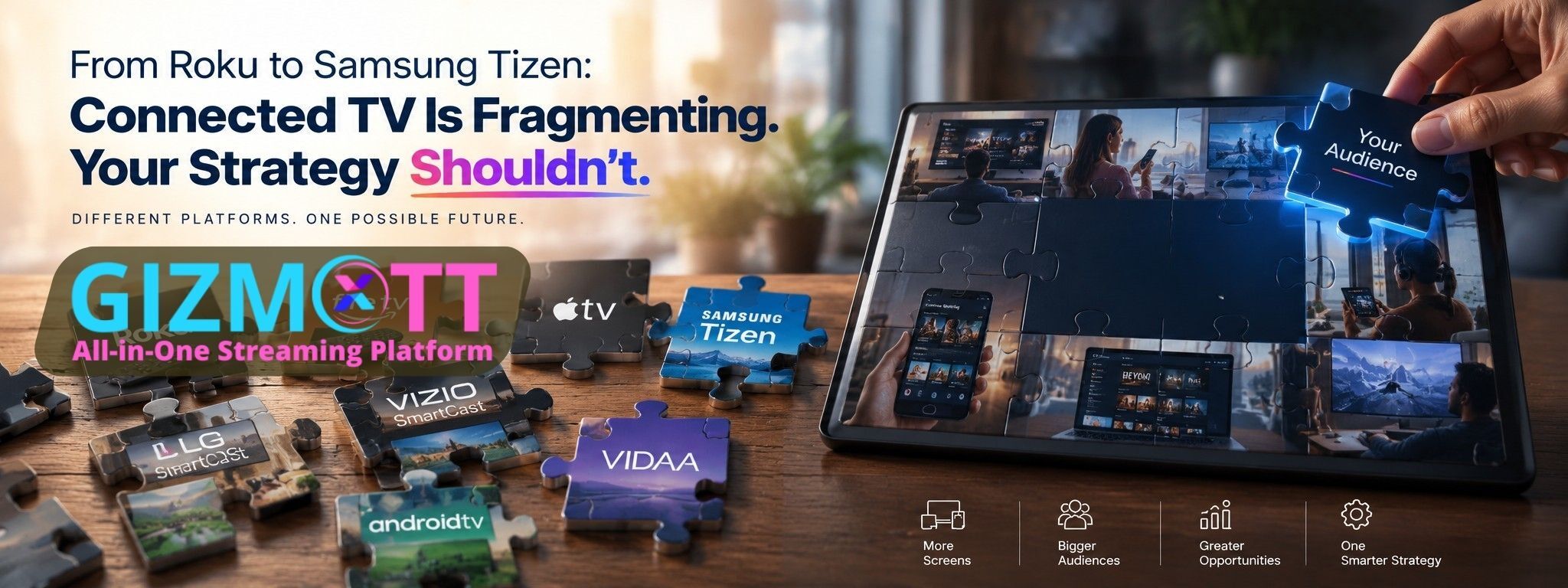
This is where the connected TV conversation becomes much bigger than Roku vs Fire TV vs Apple TV. Samsung Tizen, LG webOS, Vizio SmartCast and VIDAA represent additional ecosystems that streaming businesses need to consider when building serious CTV distribution strategies. Gizmeon’s current app development capability covers Roku, Amazon Fire TV, Apple TV, Android TV, Samsung Tizen, LG webOS, Vizio SmartCast and VIDAA, alongside iOS, Android and web applications. Gizmeon also handles platform-specific UX, remote navigation, certification and ongoing platform maintenance. That expansion changes the strategic equation. A streaming company no longer has to think about its television strategy as a choice between three devices. It can think about connected TV as a distribution layer across multiple ecosystems. And that is a much more powerful way to think about OTT.The Real Challenge Isn’t Getting Onto the Device
Getting an OTT application into an app store is only the beginning. The real challenge is what happens after the viewer opens it. Can they discover content quickly? Can they sign up easily? Can they move between devices without losing their place? Can the business understand what they are watching? Can advertising be monetized effectively? Can subscriptions, PPV or other transactions work consistently? Can the same content library support both VOD and FAST strategies? These questions reveal why OTT platform development should be considered at the business level rather than as a collection of individual applications. The application is the visible layer. The platform underneath it is what connects content, users, payments, analytics, advertising, recommendations and distribution. That is also why building every application independently can create unnecessary operational complexity. A change to the content model, subscription logic or analytics system should not require the business to rethink its entire technology stack for every device.The Winning OTT Strategy Is Consistency, Not Uniformity
There is an important distinction between consistency and uniformity. A successful multi-device OTT platform should not necessarily look identical everywhere. A television interface needs large visual elements and remote-friendly navigation. A mobile application can be faster, more interactive and optimized for touch. A web experience can focus heavily on discovery, SEO and conversion. The brand should remain consistent. The experience should remain recognizable. But the interface should respect the device. This is one reason serious connected TV app development requires platform-specific expertise rather than simply deploying the same interface everywhere. The goal is not to make every screen identical. The goal is to make every screen feel like the same streaming service.Multi-Device Distribution Also Changes Monetization
There is another reason this matters: distribution and monetization are increasingly connected. An OTT business can use different screens for different stages of the customer journey. Mobile may be the discovery environment. Web may be the conversion environment. Connected TV may become the primary viewing environment. FAST can introduce free, ad-supported programming. VOD can provide deeper catalog access. Subscriptions can monetize highly engaged audiences. A flexible OTT streaming platform should allow these models to work together rather than treating them as separate products. For example, a business could combine:- SVOD for premium or exclusive content.
- AVOD for free, ad-supported viewing.
- TVOD or PPV for individual events or releases.
- FAST channels for scheduled, lean-back viewing.
- Hybrid monetization for audiences that move between free and paid content.
Don’t Build Eight Streaming Businesses
This is perhaps the most important business lesson. If your company is building one streaming business, your technology stack should not make you feel as though you are building eight. Roku should not become one engineering project. Fire TV another. Apple TV another. Samsung another. LG another. Vizio another. The customer sees one brand. The business should operate one connected ecosystem behind it. That requires centralized content management, identity, subscriptions, analytics, monetization, APIs and operational workflows, with platform-specific applications sitting on top. Gizmeon’s platform engineering approach reflects this model: multi-device applications across Roku, Fire TV, Apple TV, Android TV, Samsung Tizen, LG webOS, iOS, Android and web, combined with platform-specific UX, certification and ongoing updates. The technology becomes the connective tissue between screens rather than another source of fragmentation.What This Means for OTT Businesses in 2026
The streaming-device conversation is becoming less about hardware and more about distribution strategy. For an OTT business, the most important questions are now:- Where does our audience watch?
- How quickly can we launch across those environments?
- Can our technology support different monetization models?
- Can we maintain one audience relationship across multiple devices?
- Can we add new platforms without rebuilding the business?
- Can our technology scale as our audience and content library grow?