
The Invisible Revolution in Streaming
The streaming industry has always been defined by visible innovation. First, it was the ability to watch content anytime, anywhere. Then came ultra-high-definition streaming, personalized recommendations, binge-worthy originals, and seamless experiences across every connected device. These consumer-facing advancements transformed how the world consumes entertainment and reshaped the media industry forever. Yet the most significant transformation happening today isn’t visible to viewers at all. It’s happening behind the scenes. As streaming platforms mature, the challenge has shifted from simply delivering content to managing it intelligently. Every movie, television series, live event, FAST channel, podcast, or microdrama released today triggers an increasingly complex chain of operational workflows before audiences ever press the Play button. Content must be organized, enriched with metadata, localized into multiple languages, optimized for search, promoted across social platforms, analyzed for performance, and monetized across multiple business models. What was once a straightforward publishing process has evolved into a sophisticated operational ecosystem that demands speed, scalability, and precision. This shift is changing how streaming businesses think about technology. For years, competitive advantage was measured by the size of a content library. Today, that advantage increasingly depends on how efficiently that content can be prepared, distributed, discovered, and optimized throughout its lifecycle. Artificial Intelligence is emerging as the technology that makes this possible. Not by replacing creativity or storytelling, but by helping streaming businesses operate more intelligently behind the scenes. The next decade of streaming won’t simply be defined by who owns the most content. It will be defined by who operates it most intelligently.Streaming Has Entered a New Era
The evolution of streaming can be viewed in three distinct phases.The first was accessibility.
Streaming liberated audiences from fixed schedules and traditional broadcasting. Viewers gained the freedom to watch what they wanted, whenever they wanted, on virtually any device. This shift fundamentally transformed consumer expectations and accelerated the decline of traditional television viewing.The second phase introduced personalization.
As content libraries expanded, recommendation engines became essential for helping viewers navigate an overwhelming number of choices. Platforms invested heavily in personalization algorithms that analyzed viewing habits, user preferences, watch history, and engagement patterns to surface relevant content for each individual subscriber. Today, personalization is no longer a differentiator—it is an expectation.The streaming industry has now entered its third phase: operational intelligence.
This evolution is being driven by the sheer scale and diversity of modern streaming ecosystems. Global OTT services continue expanding their original programming. FAST channels are growing rapidly as audiences embrace free, ad-supported viewing experiences. Independent creators are launching subscription-based platforms, while broadcasters are digitizing decades of archival content. At the same time, the explosive popularity of vertical video and microdramas has introduced entirely new content formats designed specifically for mobile-first audiences. Streaming is no longer defined by a single distribution model. Instead, it has become a dynamic ecosystem of on-demand libraries, live events, creator content, FAST programming, podcasts, and short-form entertainment delivered across multiple devices and global markets. Managing this complexity requires far more than reliable video delivery. It requires intelligent operations. Modern streaming platforms are no longer simply digital content libraries. They are sophisticated media businesses where every piece of content passes through multiple operational stages before reaching its audience. As these ecosystems continue to expand, operational efficiency is becoming just as important as content quality itself.Every Piece of Content Creates Dozens of Decisions
Creating great content is only the beginning. The real work often starts after production ends. Consider what happens when a new drama series is ready for release. Before viewers can watch the first episode, content teams begin preparing the asset for distribution. Metadata must be written and structured. Genres, cast details, descriptions, and keywords need to be organized for search and discovery. Thumbnail artwork is created in multiple formats for televisions, smartphones, tablets, and web browsers. Subtitles must be generated and reviewed. Additional language versions may be required for international audiences. Marketing teams produce promotional trailers, social media clips, and vertical previews designed for platforms where audiences increasingly discover new entertainment. Distribution teams determine release schedules across apps and connected TV platforms. Monetization rules are configured for subscriptions, advertising, transactional purchases, or hybrid business models. Finally, analytics systems begin collecting audience insights that help publishers understand engagement, retention, completion rates, and viewing behavior. This entire process repeats itself for every movie, every episode, every live stream, every FAST channel, and every microdrama released on a platform. One title may generate dozens of operational tasks. One hundred titles generate thousands. Now imagine managing a streaming service with tens of thousands of assets spread across multiple regions, devices, languages, and monetization strategies. The scale becomes extraordinary. This growing operational burden explains why many streaming businesses are rethinking how content workflows are managed. The objective is no longer simply publishing more content. It’s publishing content faster, smarter, and more efficiently without continuously expanding operational teams. As streaming platforms continue to grow, manual workflows inevitably become bottlenecks. Operational complexity—not content creation—is rapidly becoming one of the industry’s greatest challenges.Why AI Is Quietly Becoming Streaming’s Smartest Employee
Ask someone how Artificial Intelligence is being used in streaming, and the answer will usually be the same. Recommendations. For years, recommendation engines have become the public face of AI in entertainment, helping viewers discover content based on their interests and viewing history. While recommendation systems remain valuable, they represent only a small part of a much larger transformation. The most significant role AI plays today isn’t what audiences see. It’s what media companies experience behind the scenes. Artificial Intelligence is increasingly supporting the operational workflows that keep streaming businesses running efficiently. Instead of manually performing repetitive tasks, AI can assist with organizing content libraries, generating metadata, preparing subtitles, improving searchability, supporting localization, identifying relevant clips for promotion, and helping publishers make sense of vast amounts of audience data. These aren’t isolated features. Together, they form an intelligent operational layer that reduces repetitive work while improving consistency, speed, and scalability. Importantly, AI isn’t replacing creative teams. Editors still make editorial decisions. Producers still shape stories. Marketers still build campaigns. Programmers still decide what audiences should see.AI simply removes many of the repetitive, time-consuming tasks that slow those professionals down.This shift allows teams to focus on creativity, audience engagement, and business growth instead of operational administration. As content libraries continue expanding and publishing cycles become increasingly demanding, this operational support becomes more valuable than ever. The conversation surrounding AI in streaming is gradually changing. It’s no longer about whether AI can recommend the next show to watch. It’s about whether AI can help streaming businesses operate faster, scale more efficiently, and deliver better experiences across every stage of the content lifecycle. That shift marks the beginning of a new generation of streaming platforms—one where intelligence is embedded not just in the viewing experience, but throughout the entire operation itself.
AI Is Moving Beyond Recommendations
Mention Artificial Intelligence in streaming, and the first thing most people think of is content recommendations. For years, recommendation engines have been the most visible application of AI, helping viewers discover movies, series, and live content based on their viewing history and preferences. They have undoubtedly transformed how audiences navigate increasingly large content libraries. But recommendations represent only one small part of AI’s role in modern streaming. The real transformation is happening behind the scenes. As streaming platforms continue to expand their content catalogs and distribution channels, Artificial Intelligence is increasingly being embedded into the operational processes that power the business itself. Instead of solving a single problem, AI is now supporting multiple workflows simultaneously—from content preparation and localization to discoverability, audience engagement, and performance optimization. This marks a significant shift in how media companies view AI. Rather than treating it as another feature that enhances the viewing experience, AI is becoming an intelligent operational layer that supports the teams responsible for managing thousands of content assets every day. For streaming businesses, this evolution isn’t simply about automation. It’s about building platforms that can scale intelligently while allowing creative teams to focus on storytelling instead of repetitive operational tasks.From Content Ingestion to Content Discovery
Every piece of content follows a journey before it reaches an audience. It begins when content is ingested into a platform, but the work doesn’t stop there. Each asset must be prepared, organized, enriched, optimized, and ultimately presented in a way that makes it easy for viewers to discover and engage with. This is where Artificial Intelligence is reshaping the content lifecycle. AI-assisted metadata generation helps organize titles with richer descriptions, genres, keywords, and searchable information. Instead of relying entirely on manual processes, publishers can accelerate content preparation while maintaining consistency across large libraries. Localization has also become significantly more efficient through AI-powered subtitle generation and translation. As streaming services expand into new markets, the ability to prepare multilingual content quickly has become an important competitive advantage. Content promotion is undergoing a similar transformation. Publishers increasingly need promotional trailers, social media highlights, and vertical video clips that introduce audiences to new content across multiple digital platforms. AI-assisted clipping enables teams to repurpose existing assets into engaging promotional formats without rebuilding content from scratch. These capabilities may appear independent, but together they create a connected workflow where every stage of content preparation becomes faster, smarter, and easier to manage.The Rise of AI-Powered Media Operations
The conversation around AI often focuses on technology. The real conversation should focus on productivity. Streaming businesses today face increasing pressure to release more content, enter new markets, reduce operational costs, and improve audience engagement—all while working with leaner teams than ever before. Hiring larger operations teams isn’t always the answer. Building smarter workflows is. Artificial Intelligence enables media organizations to reduce the repetitive work that slows publishing pipelines. Instead of spending valuable time on routine operational tasks, teams can focus on editorial planning, programming strategy, content acquisition, audience growth, and creative storytelling.- Editors spend less time preparing repetitive assets.
- Content managers publish faster.
- Marketing teams gain promotional materials more efficiently.
- Localization becomes easier to scale.
- Audience discovery improves through richer metadata and more intelligent search experiences.
Perhaps most importantly, AI creates consistency.Whether managing hundreds of titles or hundreds of thousands, intelligent workflows help ensure that content is prepared using standardized processes while reducing manual effort across the organization. AI isn’t replacing media professionals. It’s helping them operate more effectively. That distinction will become increasingly important as streaming businesses continue growing in both size and complexity.
Why Intelligent Platforms Will Win
The next generation of streaming platforms won’t compete solely on content libraries or subscription pricing. They will compete on operational agility. As audiences demand faster releases, personalized experiences, multilingual accessibility, and content optimized for every screen, the platforms that succeed will be those capable of responding quickly without sacrificing quality or efficiency. Operational intelligence enables exactly that. Platforms equipped with AI-assisted workflows can reduce publishing timelines, improve discoverability, accelerate localization, strengthen audience engagement, and continuously optimize content performance using actionable insights. These advantages compound over time. Faster workflows allow more content to reach audiences sooner. Smarter discovery increases viewer engagement. Improved efficiency reduces operational overhead. Better analytics support stronger programming decisions. Collectively, these capabilities create a platform that becomes increasingly intelligent as it grows. The future of streaming will therefore be defined not simply by technological innovation, but by how effectively technology supports day-to-day media operations. Intelligence is no longer an optional enhancement. It is becoming an essential capability for modern streaming businesses.How GIZMOTT Is Building the Future of Intelligent Streaming
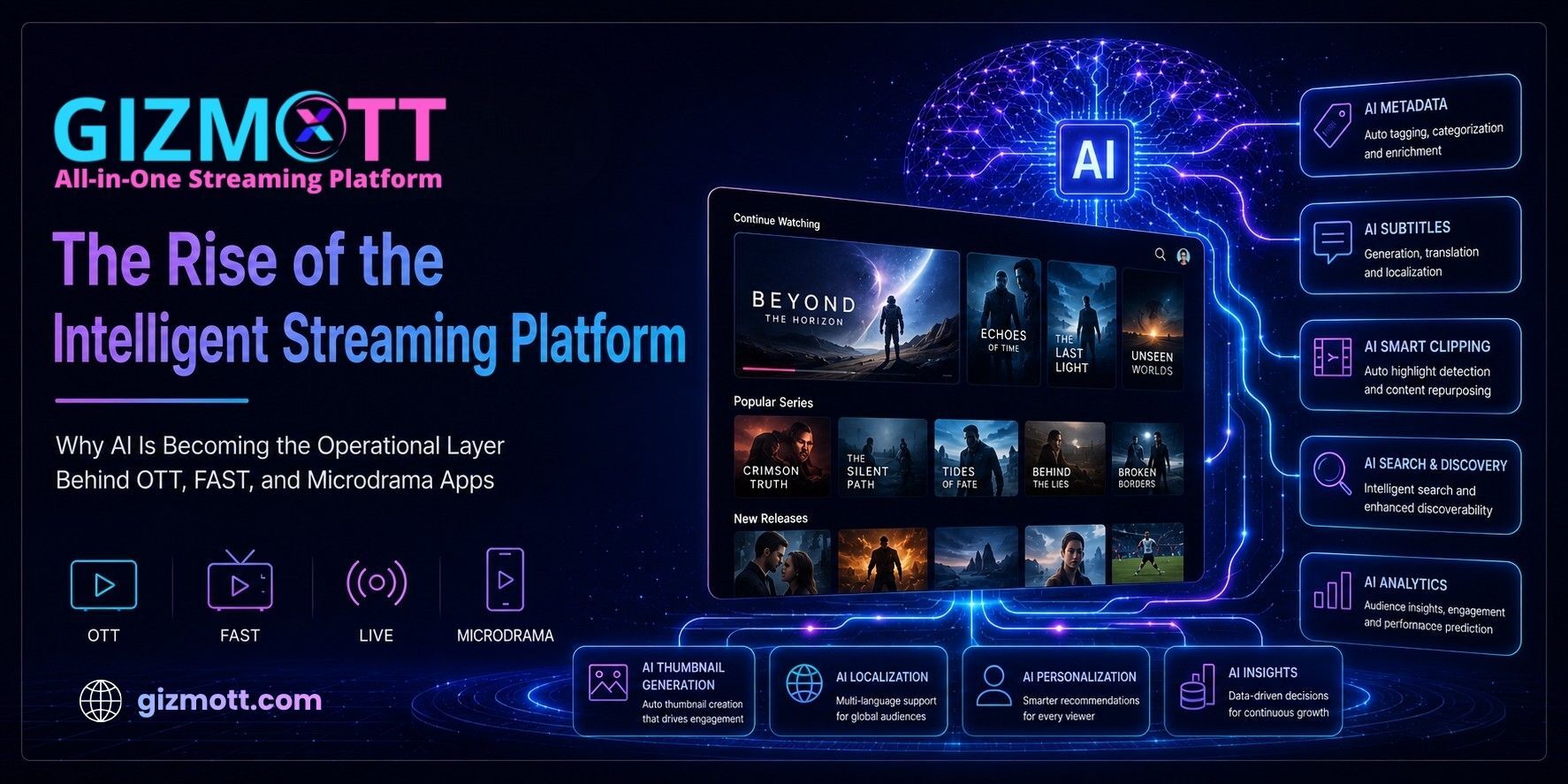
At GIZMOTT, we believe Artificial Intelligence should simplify streaming operations rather than complicate them. That’s the philosophy behind the GIZMOTT AI Hub—an integrated suite of AI-powered capabilities designed to support OTT platforms, broadcasters, FAST channels, and microdrama applications throughout the content lifecycle. Rather than offering disconnected AI tools, the AI Hub brings intelligence into the workflows streaming businesses rely on every day.- For content discovery, AI-powered recommendations help viewers find relevant content based on their interests and viewing behavior, creating more engaging and personalized experiences.
- For publishers managing extensive content libraries, AI Metadata Generation enriches titles with structured information that improves searchability, organization, and discoverability.
- Localization workflows are streamlined through AI Subtitle Generation, enabling publishers to prepare multilingual content more efficiently while expanding their reach into new markets.
- As promotional content becomes increasingly important, AI Smart Clipping helps transform long-form videos into short, engaging highlights suitable for social media, mobile-first audiences, and vertical viewing experiences—particularly valuable for the growing microdrama ecosystem.
- The AI Hub also includes AI Thumbnail Generation, helping publishers create visually engaging artwork that captures viewer attention across multiple devices and streaming environments.