
The streaming industry is entering a new phase of maturity.
For much of the past decade, growth was measured primarily through subscriber numbers. The race was straightforward: acquire audiences, expand content libraries, and scale distribution. Today, the conversation has become significantly more complex.
Media companies are increasingly focused on monetization efficiency, audience ownership, AI-powered engagement, FAST channel expansion, content discoverability, and emerging content formats such as vertical video and microdramas. The challenge is no longer simply attracting viewers. It is building sustainable, scalable streaming businesses in an increasingly competitive landscape.
Against this backdrop, StreamTV Show 2026 arrives at a pivotal moment for the industry.
More than a conference, StreamTV has become one of the most important gatherings for executives, content owners, technology providers, advertisers, broadcasters, creators, and innovators who are actively shaping the next generation of streaming.
The conversations taking place in Denver this June will offer valuable insight into where the industry is heading over the next several years. For companies operating in OTT, FAST, Connected TV, advertising, content distribution, and digital media, understanding these shifts has never been more important.
As the industry gathers once again, one thing is becoming increasingly clear:
The future of streaming will be defined not by a single technology or business model, but by how effectively organizations adapt to a rapidly changing ecosystem.
Why StreamTV Matters in Today’s Streaming Landscape
Industry events have always played an important role in bringing professionals together, but in streaming, their importance has grown considerably.
The pace of change across media and entertainment has accelerated dramatically over the last few years. New monetization models continue to emerge. Artificial Intelligence is transforming operational workflows and audience engagement. FAST channels are creating new revenue opportunities for content owners. Creator-led media businesses are becoming increasingly influential. Meanwhile, new viewing formats are reshaping audience expectations.
In such an environment, industry leaders cannot afford to operate in isolation.
StreamTV serves as a valuable forum where strategy meets execution. It provides an opportunity to move beyond industry headlines and engage directly with the people building, funding, distributing, and monetizing streaming experiences.
Unlike broader entertainment conferences, StreamTV focuses specifically on the business of streaming. The event brings together decision-makers responsible for the technologies, partnerships, content strategies, advertising models, and audience experiences driving the industry forward.
For attendees, the value extends far beyond product demonstrations.
The most meaningful outcomes often emerge from conversations around industry challenges, evolving business models, audience behavior, and long-term strategic planning.
In many ways, StreamTV functions as an annual industry pulse check—revealing where the market stands today and where it is likely to move tomorrow.
The FAST Economy Has Moved Beyond Experimentation
One of the most significant developments shaping the streaming ecosystem is the continued rise of FAST (Free Ad-Supported Streaming Television).
Just a few years ago, FAST was viewed by many as an emerging opportunity. Today, it has become a critical component of the streaming economy.
Consumers increasingly seek flexible viewing options that do not require multiple subscription commitments. At the same time, content owners are looking for new ways to monetize existing libraries, expand distribution, and generate recurring advertising revenue.
These converging trends have created significant momentum for FAST.
Broadcasters, studios, rights holders, and independent content owners are increasingly evaluating how dedicated FAST channels can complement existing distribution strategies. For many organizations, FAST now represents a practical pathway to audience growth and monetization without the barriers associated with traditional subscription models.
As advertising spending continues to migrate toward Connected TV environments, FAST channels are becoming an increasingly attractive proposition for both media companies and advertisers.
It is no surprise that FAST remains one of the most discussed topics across the streaming industry, and it is expected to be a central theme throughout StreamTV Show 2026.
Artificial Intelligence Is Becoming Streaming Infrastructure
Few topics have generated more industry discussion over the past year than Artificial Intelligence.
However, the conversation around AI in streaming has evolved significantly.
The initial focus centered largely on content generation and automation. Today, the industry is increasingly focused on practical applications that create measurable business value.
Streaming platforms are investing in AI-powered content discovery, audience analytics, recommendation engines, metadata generation, operational workflows, and monetization optimization.
The reason is simple.
As content libraries continue to expand, the challenge of connecting viewers with relevant content becomes increasingly complex. The ability to surface the right content to the right audience at the right moment has become a competitive advantage.
AI is emerging as the technology layer capable of solving this challenge.
Beyond recommendations, AI is helping operators better understand audience behavior, identify engagement patterns, improve retention strategies, automate repetitive processes, and unlock deeper insights from content performance data.
The most successful streaming businesses over the next decade will likely be those that combine compelling content with intelligent audience experiences.
This is why AI is rapidly transitioning from an optional enhancement to a foundational component of modern streaming infrastructure.
Vertical Media and Microdramas Are Creating New Opportunities
Another major topic likely to dominate industry conversations is the emergence of vertical media and microdrama content.
What began as a mobile-first viewing trend has rapidly evolved into a legitimate content category attracting attention from producers, studios, investors, technology providers, and media executives worldwide.
The growth of dedicated microdrama platforms, short-form storytelling models, and vertical-first content experiences reflects a broader shift in audience consumption habits.
Viewers increasingly consume content on mobile devices. Attention spans are changing. Content discovery mechanisms are evolving. New monetization models are emerging.
These factors have created fertile ground for new content formats.
Recent industry gatherings dedicated to vertical media have highlighted the growing interest in this space, with conversations extending beyond content production into platform infrastructure, monetization, audience acquisition, and distribution strategies.
For technology providers and content owners alike, the rise of vertical media represents more than a content trend.
It represents the emergence of an entirely new streaming category.
Organizations that understand this shift early may find themselves well-positioned to capitalize on one of the industry’s fastest-growing segments.
The Return of Audience Ownership
One of the most important strategic shifts occurring across the media industry is the renewed focus on audience ownership.
For years, many publishers, creators, and media businesses prioritized reach above all else. Third-party platforms offered access to massive audiences, making them attractive distribution channels.
However, the limitations of this model have become increasingly apparent.
Organizations are recognizing the value of owning their audience relationships, controlling their data, and managing their monetization strategies directly.
As a result, many media companies are investing in branded OTT applications, direct-to-consumer platforms, proprietary streaming experiences, and owned distribution channels.
The objective is not merely distribution.
It is long-term business sustainability.
First-party audience relationships provide greater control over engagement, retention, monetization, and strategic growth.
This shift is driving demand for flexible streaming infrastructure capable of supporting diverse content models and evolving business requirements.
It is also one of the reasons conversations around platform technology have become increasingly important at industry events such as StreamTV.
GIZMOTT Supports the Next Generation of Streaming!
The trends discussed throughout StreamTV—FAST, AI, audience ownership, OTT expansion, live streaming, and vertical media—share a common requirement.
They all depend on technology infrastructure.
At Gizmeon, we have witnessed growing demand from media companies seeking solutions that can support multiple business models simultaneously while remaining scalable, flexible, and future-ready.
Through GIZMOTT, we help media companies, broadcasters, content owners, creators, and entertainment businesses build streaming ecosystems designed for today’s market realities.
The modern streaming business is no longer limited to launching a basic OTT application.
Organizations increasingly require technology capable of supporting:
- Subscription streaming services
- FAST channel deployment
- Live events and live streaming
- AI-powered recommendations and analytics
- Vertical video and microdrama experiences
- Hybrid monetization models
- Multi-platform audience engagement
- Connected TV, web, and mobile distribution
What makes this moment particularly interesting is that many of these capabilities are beginning to converge.
A content owner launching a streaming platform today may simultaneously explore FAST distribution, AI-powered engagement, vertical content initiatives, and multiple monetization strategies.
The need for unified, scalable infrastructure has never been greater.
This is precisely why conversations around technology strategy have become central to events like StreamTV.
Why Meeting Industry Peers Still Matters
In an increasingly digital industry, face-to-face conversations remain incredibly valuable.
Technology can facilitate communication, but meaningful business relationships are still built through direct interaction.
Events such as StreamTV create opportunities to discuss challenges, exchange ideas, evaluate market trends, and explore potential partnerships in ways that virtual interactions often cannot replicate.
The streaming industry remains one of the most collaborative sectors within media and entertainment.
Content owners need technology partners.
Technology providers need market feedback.
Advertisers need distribution opportunities.
Creators need monetization pathways.
Investors need visibility into emerging trends.
Bringing these stakeholders together creates the conditions necessary for innovation.
The conversations that begin at industry events frequently evolve into strategic partnerships, new business ventures, and transformative opportunities.
That is one of the reasons StreamTV continues to be such an important event within the streaming ecosystem.
Looking Ahead
The streaming industry is no longer defined solely by content.
It is increasingly shaped by technology, monetization, audience engagement, distribution strategy, and operational intelligence.
FAST channels are becoming mainstream. Artificial Intelligence is becoming infrastructure. Vertical media is creating new opportunities. Audience ownership is becoming a strategic priority.
These developments are reshaping how media businesses operate and compete.
As StreamTV Show 2026 brings together leaders from across the streaming ecosystem, the event offers a unique opportunity to understand where the industry is today—and where it is heading next.
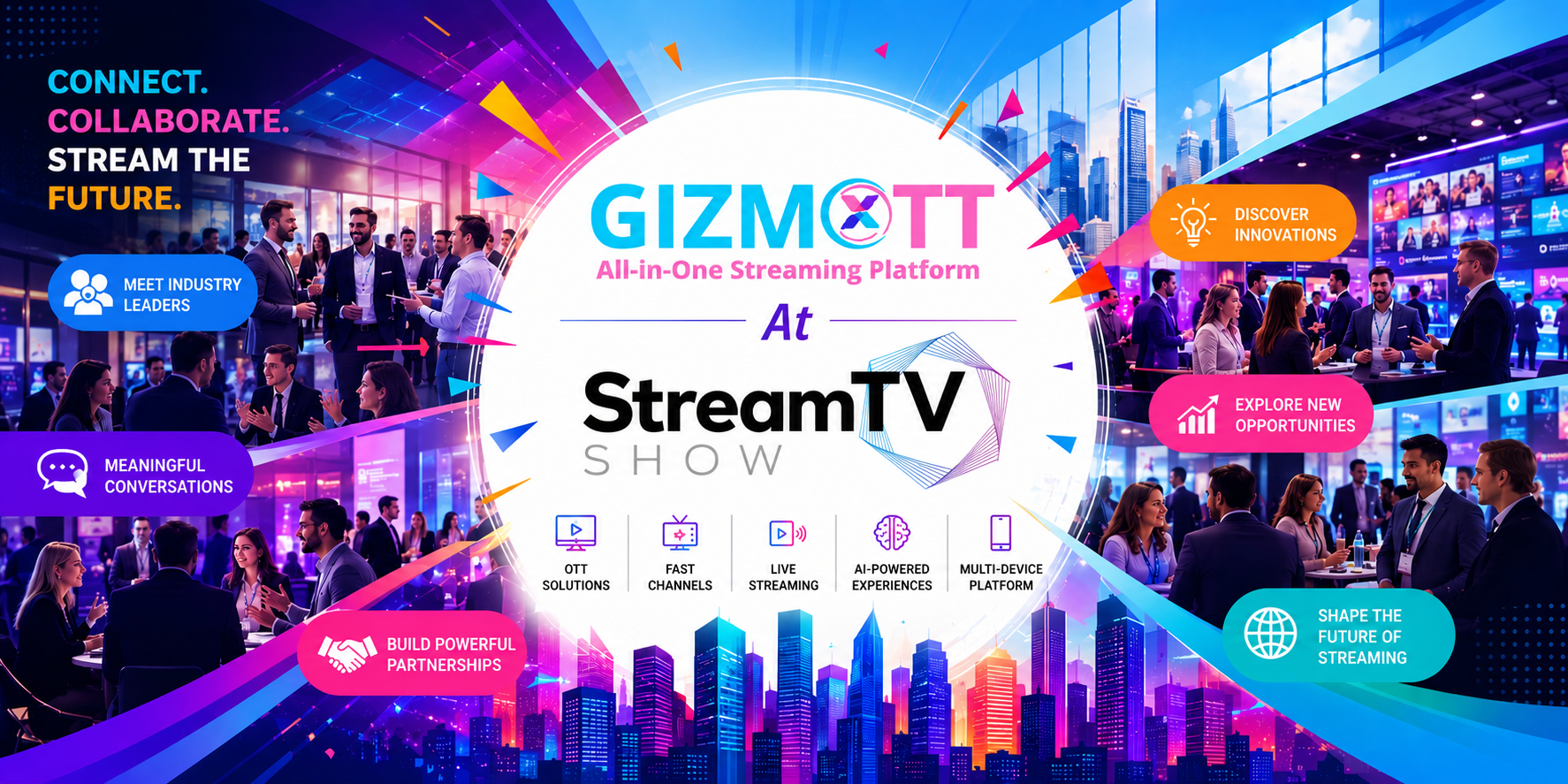
The GIZMOTT team will be attending throughout the event and would welcome the opportunity to connect with fellow media professionals, content owners, broadcasters, creators, and technology leaders.
If you’re attending StreamTV Show 2026, visit us at Booth #313 to discuss the future of streaming, explore emerging opportunities, and exchange perspectives on the trends transforming the industry.
Because the future of streaming is not being built by any one company alone.
It is being shaped through the conversations, partnerships, and innovations happening across the industry today.