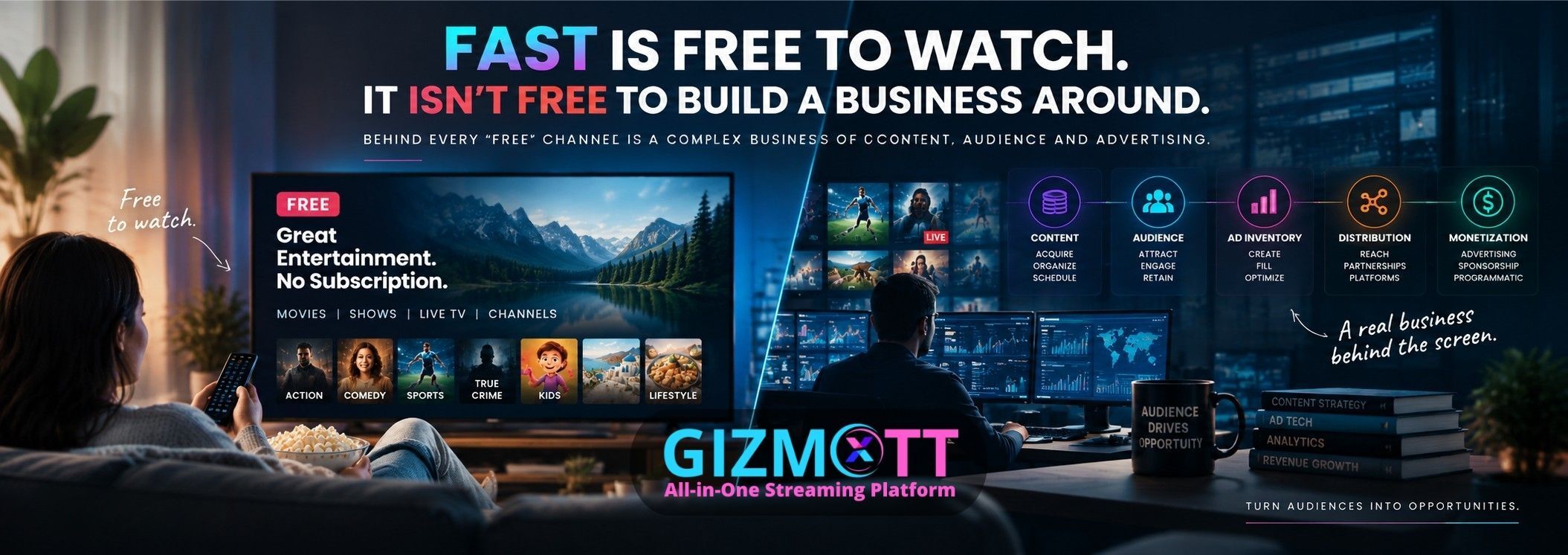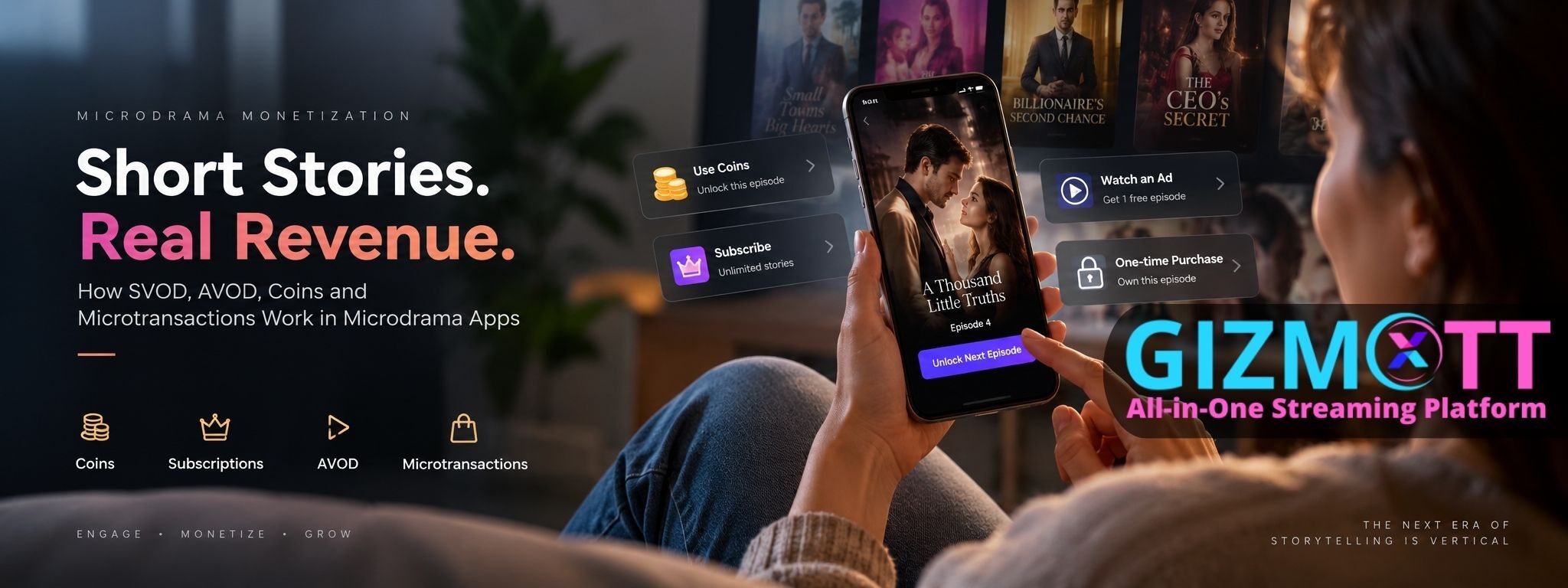

At GIZMOTT, this challenge shows up repeatedly across platforms building owned OTT apps, launching FAST channels, or expanding into ad-supported models. The pattern is consistent: single-model monetization no longer works at scale. Sustainable growth now depends on hybrid monetization strategies that combine multiple revenue streams without compromising user experience or operational stability.
Understanding how monetization really works in modern streaming platforms and how to implement it correctly is no longer optional.
The OTT Monetization Landscape: What Exists Today
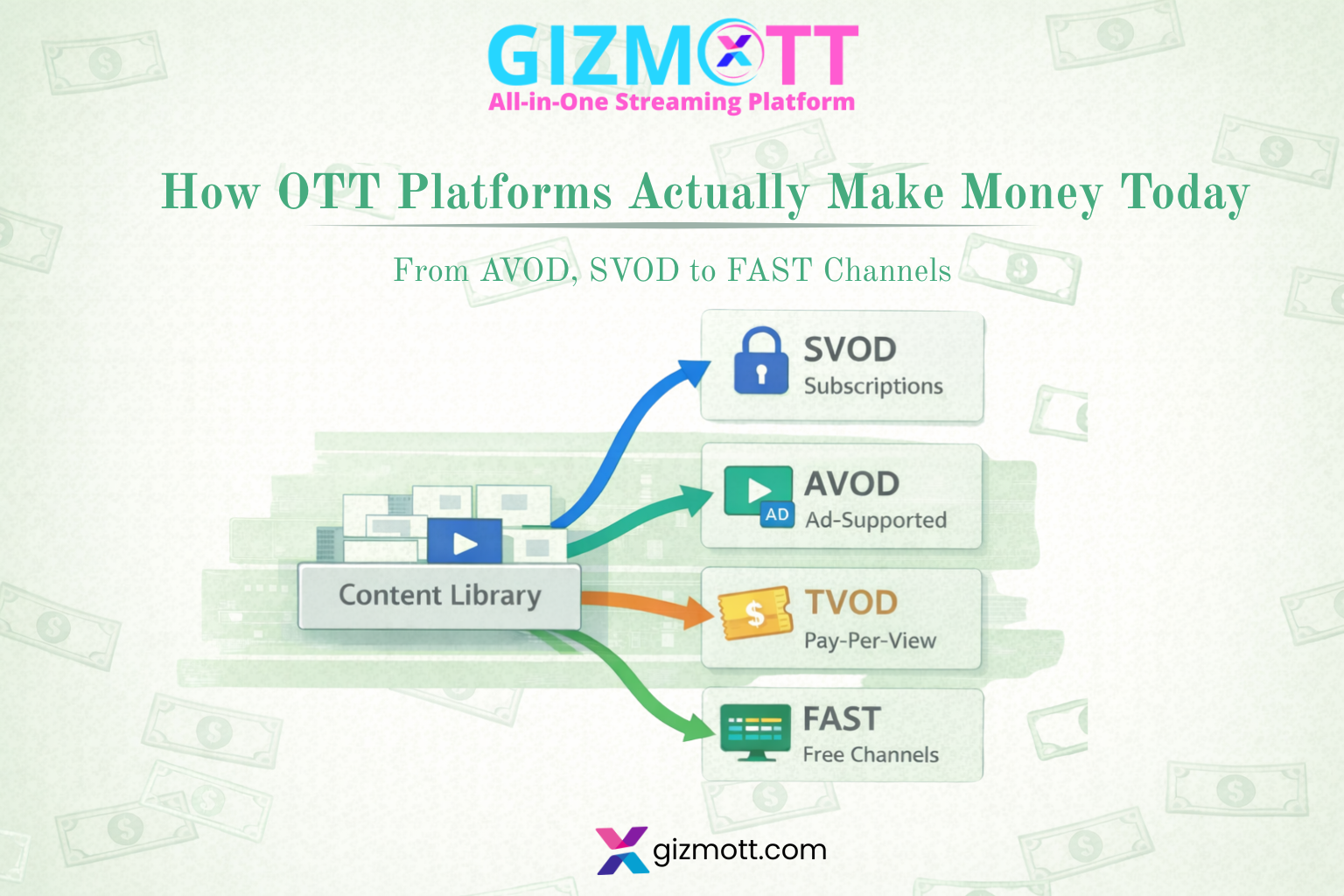
Before examining why hybrid monetization models outperform, it’s important to define the core monetization options used by OTT and streaming platforms today. The OTT monetization landscape includes subscription-based (SVOD), ad-supported (AVOD), transactional (TVOD), and FAST channel models, each designed to address different viewer behaviours and revenue goals.
While each model can be effective in isolation, none fully supports the diverse ways audiences consume content across devices, regions, and price sensitivities. Understanding the strengths and limitations of these monetization models is essential for building scalable, sustainable OTT platforms and sets the foundation for adopting hybrid monetization strategies.
1. SVOD (Subscription Video on Demand)
SVOD remains the most familiar and widely adopted monetization model in the OTT ecosystem. Under this model, users pay a recurring subscription fee (typically monthly or annually) for unlimited access to a platform’s content library. SVOD has historically powered the early growth of many streaming platforms by offering predictable revenue and a direct relationship with viewers. However, as the market has matured and competition has intensified, the limitations of relying solely on subscriptions have become increasingly apparent.
Where SVOD works well
- Premium or exclusive content
- Strong brand loyalty
- Predictable baseline revenue
Where SVOD struggles
- Subscription fatigue
- High churn rates
- Price sensitivity across regions
- Slower growth once saturation is reached
SVOD creates stability early, but over time it becomes rigid. Many platforms discover that growth plateaus once audiences hit price resistance.
2. AVOD (Ad-Supported Video on Demand)
AVOD removes the paywall by monetizing content through advertising, allowing viewers to watch for free while platforms generate revenue from ads placed before or during playback. As subscription fatigue increases, AVOD has become a key growth lever for OTT platforms seeking broader reach. Its effectiveness, however, depends heavily on playback stability, accurate ad insertion, and overall quality of experience, all of which directly impact viewer retention and monetization.
Strengths of AVOD
- Lower barrier to entry
- Rapid audience growth
- Effective in price-sensitive markets
Operational challenges
- Requires significant scale for meaningful revenue
- Ad delivery is tightly coupled with playback quality
- Buffering or failures directly reduce monetization
AVOD is powerful but only when playback reliability, SSAI, and analytics are handled correctly.
3. TVOD (Transactional / Pay-Per-View)
TVOD enables users to pay for individual titles, live events, or time-bound premium access rather than committing to an ongoing subscription. This model is commonly used for high-value content such as live sports, concerts, special releases, or exclusive screenings where immediacy or scarcity drives willingness to pay. While TVOD can generate strong short-term revenue, it is inherently episodic and works best when combined with other monetization models to maintain consistent engagement and long-term value.
Where TVOD excels
- Live sports or events
- Early-access or exclusive releases
- Niche or high-value content
Limitations
- Inconsistent revenue
- High user friction
- Difficult to scale as a standalone model
TVOD works best as a complementary layer, not a primary revenue strategy.
4. FAST (Free Ad-Supported Television)
FAST channels deliver always-on, linear programming supported by advertising, offering viewers a familiar, lean-back experience similar to traditional television. This model has grown rapidly as audiences gravitate toward free, curated content streams that require minimal decision-making. For platforms and content owners, FAST provides an efficient way to monetize large content libraries at scale, though success depends heavily on reliable playout, consistent scheduling, and stable ad delivery.
Why FAST is attractive
- Lean-back viewing experience
- Monetizes large content libraries
- Scales ad inventory efficiently
What FAST demands operationally
- Precise scheduling
- Reliable playout
- Server-side ad insertion
- High uptime across devices
FAST monetization is highly sensitive to stability and consistency. Even brief failures result in lost impressions and revenue.
Why Single-Model Monetization Is No Longer Enough
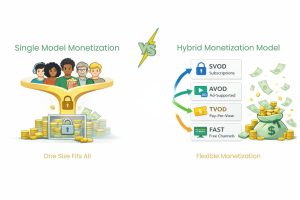
Each monetization model optimizes for a specific type of viewer behaviour. But real audiences don’t behave uniformly.
Some viewers:
- Are willing to pay for premium access
- Prefer free content with ads
- Engage occasionally through transactions
- Switch behaviour depending on content or context
When platforms force all users into one monetization path, they lose flexibility and revenue. This is why hybrid monetization has shifted from being an experiment to becoming the dominant strategy.
What Hybrid Monetization Really Means
Hybrid monetization is often misunderstood. It is not simply about adding multiple revenue models or copying the strategies of large streaming platforms without the infrastructure to support them. Instead, hybrid monetization is a deliberate approach to aligning how content is monetized with how different audiences actually engage with a platform.
At its core, hybrid monetization means:
- Matching monetization strategies to viewer intent and behaviour
- Allowing users to move seamlessly between monetization models
- Monetizing the same content differently based on context, device, or region
- Using data and control layers to manage access, pricing, and entitlements
- Focusing on long-term lifetime value rather than short-term ARPU
Common hybrid examples
- Free AVOD tier with a paid ad-free upgrade (SVOD)
- FAST channels driving discovery → VOD monetization
- TVOD for live events + AVOD for replays
- Region-specific monetization strategies
The success of hybrid monetization lies in choice and adaptability.
Why Hybrid Monetization Works Best
As viewer behaviour becomes more fragmented and market conditions continue to shift, single-revenue monetization strategies struggle to keep pace. Platforms that rely on only subscriptions, only advertising, or only transactions are increasingly exposed to churn, pricing pressure, and demand volatility. Hybrid monetization works best because it allows streaming platforms to respond to these realities with flexibility, resilience, and scale.
Hybrid models consistently outperform single-revenue strategies because they:
- Reduce churn by offering flexibility
- Expand reach without sacrificing revenue
- Monetize multiple audience segments simultaneously
- Adapt to regional economics and consumption habits
- Diversify risk across revenue streams
Instead of relying on one fragile source of income, platforms build resilient monetization ecosystems.
The Hidden Challenge: Monetization Is an Infrastructure Problem
While hybrid monetization sounds attractive, many platforms fail during execution.
Why?
Because hybrid monetization requires deep platform capabilities, not surface-level features.
Platforms must support:
- Seamless switching between monetization models
- Entitlement and access control
- Subscription management
- SSAI for AVOD and FAST
- Linear scheduling and playout
- Unified analytics across monetization types
- Consistent playback across devices
Without a unified foundation, monetization becomes fragmented, error-prone, and difficult to scale.
How GIZMOTT Enables Hybrid Monetization at Scale
This is where GIZMOTT fits naturally not as a monetization idea, but as the execution layer.
GIZMOTT supports hybrid monetization by enabling platforms to:
- Launch and operate SVOD, AVOD, TVOD, and FAST within a single ecosystem
- Manage subscriptions, entitlements, and access rules centrally
- Deliver ads through server-side ad insertion (SSAI) for reliable monetization
- Run linear FAST channels alongside on-demand catalogs
- Track viewer behaviour and monetization performance across models
- Scale across devices, regions, and content types without operational fragmentation
The focus is not on adding more monetization options but on making monetization dependable, measurable, and adaptable.
Monetization Strategy Is Now a Product Decision
The most successful streaming platforms no longer ask:
Which monetization model should we choose?
They ask:
“How many monetization paths can our platform support without breaking experience or operations?”
Hybrid monetization is not a trend it’s a response to how viewers actually consume content. Platforms that treat monetization as infrastructure not an afterthought are the ones building sustainable streaming businesses.
Where the Money Actually Is
The future of OTT monetization isn’t about choosing between subscriptions, ads, transactions, or FAST it’s about building platforms flexible enough to support all of them at once. As viewer behavior fragments and market conditions shift, revenue follows platforms that can adapt without breaking experience or operations. Hybrid monetization works not because it is complex, but because it reflects how audiences actually consume content. For streaming platforms, the real opportunity lies in treating monetization as a core platform capability one that evolves with viewers, scales across models, and turns flexibility into sustained revenue.
In the next phase of streaming, monetization will not be about choosing sides. It will be about building platforms flexible enough to support them all.