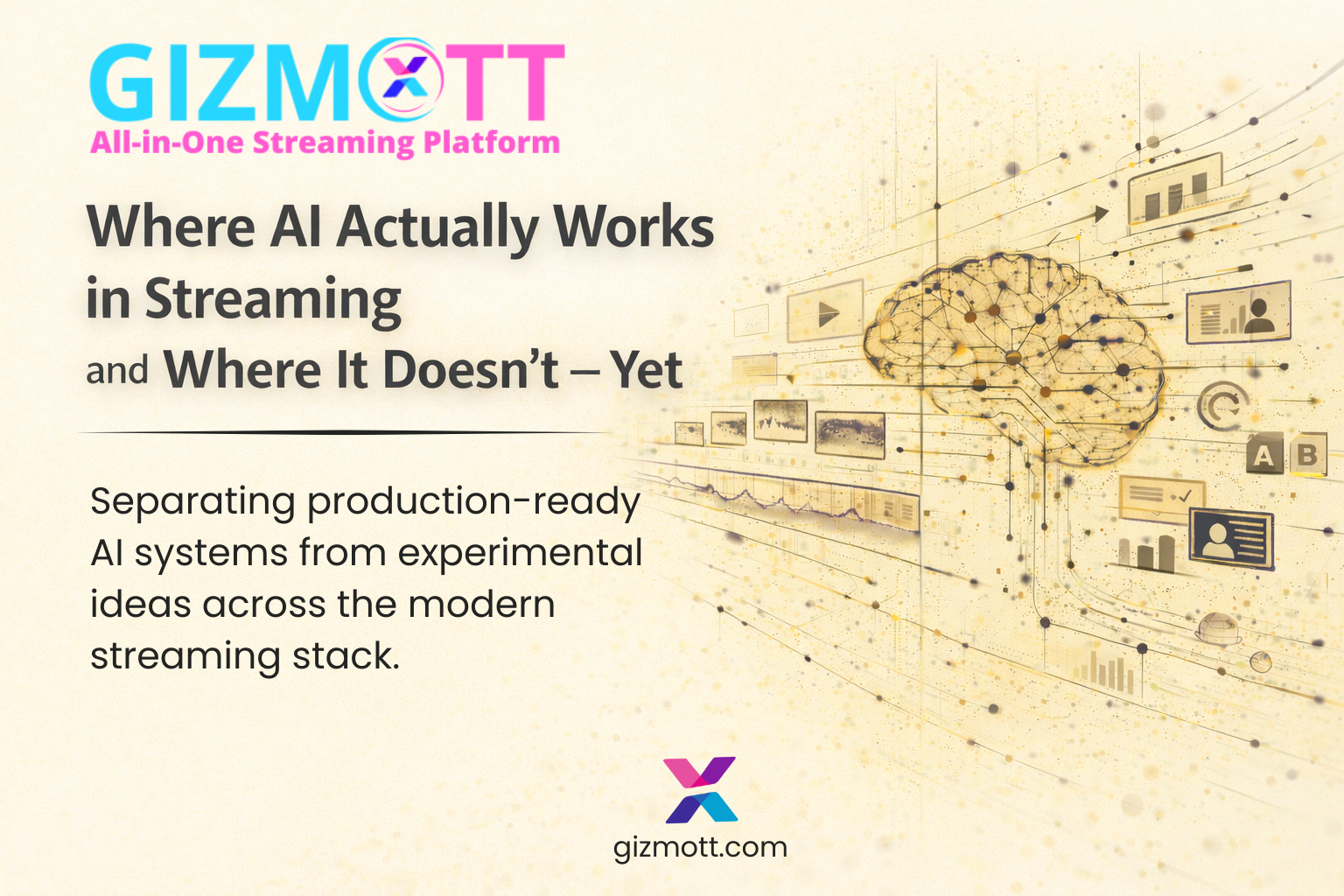

Where AI Actually Works in Streaming and Where It Doesn’t – Yet
AI in OTT and streaming platforms is no longer a futuristic buzzword—it’s actively shaping how content is discovered, personalized, monetized, and moderated. From recommendation engines to AI-powered analytics, streaming businesses are experimenting with automation while learning its real-world limits.
This distinction matters. For streaming platforms, AI is no longer about novelty—it is about reliability, scale, and return on investment. At GIZMOTT, this shift is reflected in how AI is applied across OTT platforms and FAST channels: as part of the core streaming infrastructure, not as a standalone feature—focused on measurable outcomes across discovery, delivery, and monetization. Understanding where AI truly works, and where it does not yet, is essential for platforms looking to deploy it responsibly and effectively.
Where AI Is Already Delivering Real Value
Personalization and Recommendations
The most established and commercially impactful use of AI in streaming remains personalization. Recommendation systems today operate as multi-layered decision engines rather than simple content matching tools. They analyze a mix of behavioral data, contextual signals, and content attributes to predict what a user is most likely to watch—and finish.
In practice, these systems:
- Continuously adapt to short-term viewing behavior while learning from long-term preferences
- Balance relevance with diversity to avoid content fatigue
- Align recommendations with broader business goals such as retention, engagement, and catalog exposure
At scale, even marginal improvements in recommendation accuracy translate into meaningful gains in watch time and subscriber lifetime value. This is one of the clearest examples of AI directly influencing revenue outcomes in streaming—and a core area where platforms using Gizmott operationalize AI as part of their viewer experience layer.
Encoding, Compression, and Delivery Optimization
AI also plays a critical role behind the scenes. Machine-learning models are increasingly used to optimize video encoding by predicting perceptual quality rather than relying solely on static bitrate ladders. This allows platforms to reduce bandwidth consumption while maintaining—or even improving—viewer-perceived quality.
Operationally, this enables:
- Smarter bitrate allocation based on scene complexity
- Lower delivery costs across global CDN networks
- More stable playback on constrained or variable connections
These optimizations are largely invisible to viewers, yet they materially impact margins and quality of experience at scale.
Platforms deploying AI through unified streaming infrastructure—such as Gizmott—tend to see the strongest results here, where efficiency and reliability intersect.
Subtitles, Transcription, and Metadata Automation
Speech recognition and natural language processing have significantly reduced the friction involved in making content searchable and accessible. Automated transcription, captioning, and metadata generation are now standard components of modern streaming workflows.
Their value lies in speed and scale:
- Faster turnaround for captions and translations
- Improved accessibility across regions and languages
- Richer metadata that improves search and discovery
While human review remains essential for quality assurance—especially for nuanced dialogue or less-resourced languages—the productivity gains are well established. For platforms managing large catalogs or FAST channel lineups, this automation has become foundational rather than optional.
Where AI Helps, but Does Not Replace Humans
Assisted Creative Workflows
Generative AI has found a practical role in assisting creative teams, not replacing them. Tools that suggest rough cuts, generate thumbnail variants, or surface stylistic alternatives can meaningfully accelerate post-production workflows.
In these contexts, AI functions best as:
- A rapid ideation partner
- A way to explore multiple creative directions efficiently
- A tool for handling repetitive or time-intensive tasks
Final creative authority, however, remains human. Narrative coherence, emotional pacing, and brand alignment require judgment and intent that AI does not possess—an important boundary for streaming platforms producing original or premium content.
Where AI Still Falls Short
Creative Intent and Storytelling
Despite advances in generative models, AI struggles with creative intent. It can reproduce patterns and styles, but it does not understand why a story resonates or when to break convention for impact. Fully autonomous creative decision-making often results in content that is technically competent but emotionally flat.
For streaming platforms, this reinforces a key principle: AI can support creativity, but it cannot author it.
Rights, Provenance, and Synthetic Content
AI-generated audio and video have introduced new complexity around rights management. Platforms increasingly face challenges related to:
- Identifying synthetic or partially synthetic works
- Determining ownership and royalty eligibility
- Preventing large-scale upload fraud
While detection tools and watermarking techniques are improving, enforcement and policy frameworks are still evolving. This remains one of the most legally sensitive areas of AI adoption—particularly for platforms operating at scale.
Trust, Safety, and Moderation
Deepfakes and non-consensual synthetic media present growing risks. Automated detection systems help flag suspicious content, but adversarial techniques evolve quickly. Effective moderation requires a layered approach:
- Automated detection for scale
- Human review for edge cases
- Clear reporting and remediation pathways
Technology alone is insufficient without governance and accountability structures.
Transparency and Bias
Many AI systems used in streaming—particularly recommendation engines—operate as black boxes. As regulatory scrutiny increases and user expectations around transparency grow, platforms face pressure to better understand and explain how these systems behave.
Bias in training data can skew exposure and discovery, potentially disadvantaging certain creators or genres. Addressing this requires ongoing monitoring and governance, not one-time fixes.
Practical Guidance for Streaming Leaders
For AI initiatives to succeed, streaming platforms must prioritize pragmatism over hype:
- Focus on business outcomes, not model novelty
- Deploy AI as an augmentation layer, not a replacement
- Maintain human oversight for high-risk decisions
- Invest early in governance, provenance, and auditability
- Design workflows that assume models will occasionally fail
At Gizmott, the most successful implementations treat AI as streaming infrastructure—powerful, measurable, and carefully managed across discovery, delivery, monetization, and operations.
Conclusion
AI is already indispensable to streaming, but not in the ways most often advertised. Its greatest strengths lie in personalization, operational efficiency, and scalable automation. Its weaknesses emerge when asked to replace human judgment, creative intent, or legal clarity.
The next phase of AI adoption in streaming will not be defined by spectacle, but by discipline: using the technology where it demonstrably works, constraining it where it does not, and building systems that respect both creative integrity and user trust. For platforms that get this balance right and for those building on scalable foundations like Gizmott AI is not a disruption. It is a durable competitive advantage.