
The Day the Creator Economy Stopped Being About Content
Something changed in 2026. Not because another social platform launched a new feature. Not because AI introduced another content creation tool. And certainly not because creators suddenly became more influential overnight. The shift was far more significant. For years, the creator economy was discussed as a marketing trend. Brands looked at creators as distribution channels. Platforms looked at them as engagement drivers. Investors viewed them as a fast-growing asset class. Everyone talked about creators, but very few talked about what creators were actually becoming. This year, that conversation changed. At Cannes Lions 2026, one of the world’s most influential gatherings for advertising, media, and marketing, creators weren’t treated as an emerging category—they became central to the conversation. Discussions focused less on influencer campaigns and more on creator-led businesses, intellectual property, AI-powered production, and long-term ownership. Adobe captured the moment by stating that“the creator economy isn’t emerging anymore. It’s becoming the center of gravity for how culture is created, distributed and monetized.”That statement is more profound than it appears. It signals that the creator economy has moved beyond content creation and entered a new phase—one where creators are building sustainable businesses instead of simply growing audiences. This distinction matters because business models outlast algorithms. A creator with ten million followers can lose visibility after a single platform update. A creator who owns a subscription business, a branded streaming platform, premium communities, and direct customer relationships is building something far more resilient. The next generation of creator success won’t be determined by how many people discover your content. It will be determined by how many people choose to stay with your business.
The Real Product Isn’t Content Anymore
Ask someone what creators produce, and the obvious answer is content.- Videos.
- Podcasts.
- Livestreams.
- Short-form clips.
- Newsletters.
- Courses.
- Trust
- Community
- Recurring relationships
- Attention
- Expertise
- Data
- Commerce
- Intellectual property
Followers Are Becoming Balance Sheets
For over a decade, social media rewarded one metric above all else. Followers. Brands negotiated partnerships based on reach. Creators measured success through subscriber counts. Platforms celebrated monthly active users. Yet inside boardrooms, investors were asking a very different question. “Where does the revenue actually come from?” Follower count is a visibility metric. Business value is a monetization metric. The creator businesses commanding the highest valuations today are rarely dependent on a single source of income. Instead, they resemble diversified media companies with multiple recurring revenue streams. A modern creator business might generate income through:- Subscription memberships
- Premium streaming content
- Advertising
- Brand partnerships
- Merchandise
- Digital products
- Online education
- Licensing intellectual property
- Live experiences
- Affiliate commerce
A Quiet Transformation Is Happening Behind the Camera
There’s another change that’s receiving far less attention than AI or platform algorithms. The tools creators invest in are changing. Five years ago, creator technology primarily meant cameras, editing software, microphones, and scheduling platforms. Today, the technology stack looks remarkably different. Creators are investing in:- Customer Relationship Management (CRM)
- Subscription management
- Analytics platforms
- AI-assisted production
- Community management
- Commerce integrations
- OTT streaming platforms
- Mobile applications
- First-party data infrastructure
- Multi-platform content distribution
The Great Migration Nobody Is Talking About
If the first phase of the creator economy was about building an audience, the second phase is about building an asset. That distinction changes everything. For over a decade, social media platforms became the launchpad for millions of creators. They democratized publishing, lowered barriers to entry, and enabled individuals to reach global audiences without the backing of traditional media companies. It was an extraordinary transformation. But every platform came with an invisible trade-off. Creators owned the content. The platforms owned the audience. Every recommendation, every subscriber notification, every monetization rule, and every algorithm update remained outside the creator’s control. Businesses worth millions of dollars could see their reach fluctuate overnight because of a product decision made thousands of miles away. That realization is quietly reshaping the industry’s priorities. The most successful creators are no longer trying to escape social media. They’re simply refusing to build their entire business on it. Social platforms are increasingly becoming discovery engines. Owned platforms are becoming business engines. It’s a subtle but profound shift. YouTube, Instagram, TikTok, and Facebook remain invaluable for attracting new audiences, but they’re increasingly serving as the top of the funnel rather than the final destination. The goal is no longer just to gain followers. It’s to build direct relationships.Attention Is Borrowed. Ownership Is Earned.
Every business eventually faces the same strategic question. Who owns the customer relationship? Traditional broadcasters answered that question decades ago. Streaming giants answered it again when they moved away from cable distribution. Now creators are confronting exactly the same challenge. Consider the world’s largest streaming businesses. Their greatest competitive advantage isn’t simply their content libraries. It’s the fact that they know exactly who their customers are. They understand viewing habits.- Retention patterns.
- Purchase history.
- Device preferences.
- Subscription behaviour.
- Content consumption.
- Views.
- Likes.
- Shares.
- Engagement rates.
- Pricing strategies.
- Membership tiers.
- Advertising decisions.
- Content investments.
- Community engagement.
Hollywood Isn’t Competing With Creators Anymore
One of the most interesting developments in 2026 isn’t happening on social media. It’s happening inside Hollywood. For years, traditional entertainment viewed digital creators as an entirely separate ecosystem. Studios produced films. Creators made YouTube videos. Networks developed television. Influencers created social content. Those boundaries are rapidly disappearing. The launch of the Creator Economy Summit at the Cannes Film Market this year wasn’t simply another conference addition. It represented something much larger. The film industry openly acknowledged that creator-led storytelling has become part of mainstream entertainment. Studios are increasingly collaborating with creators. Streaming platforms are investing in creator-led programming. Production companies are exploring partnerships with digital talent who already possess loyal communities. The direction of travel is becoming unmistakable. Hollywood is no longer asking, “How do we compete with creators?” It’s asking, “How do we work with them?” That represents one of the biggest validations the creator economy has received. Not because creators replaced traditional media. But because they’ve become part of it.AI Didn’t Replace Creativity. It Raised the Bar.
Few topics have dominated industry conversations more than Artificial Intelligence. Depending on who you ask, AI is either the greatest opportunity the creator economy has ever seen—or its biggest threat. The reality, however, lies somewhere in between. Throughout Cannes Lions 2026, one message emerged consistently: AI isn’t replacing creativity; it’s accelerating the creative process. Today’s creators can generate subtitles in seconds, translate content into multiple languages, repurpose long-form videos into short-form clips, create thumbnails, write descriptions, develop marketing assets, and automate repetitive production tasks with remarkable speed. These capabilities don’t replace storytelling—they remove the operational friction that often slows it down. That distinction is what makes AI so transformative. As technology simplifies production, originality becomes even more valuable because authentic ideas are far harder to replicate than automated workflows. Trust, personality, perspective, and genuine human connection are becoming the true differentiators in an increasingly AI-assisted world. The creators who will thrive over the next decade won’t necessarily be those using the most AI tools; they’ll be the ones using AI strategically to spend less time on repetitive tasks and more time building meaningful relationships, stronger communities, and enduring brands.Infrastructure Is Becoming the New Competitive Advantage
For years, competitive advantage came from content volume.- Publish more.
- Post faster.
- Upload daily.
- Go live more often.
- Subscription management
- Intelligent content discovery
- Personalized recommendations
- Audience analytics
- Community engagement
- Multi-platform distribution
- Live streaming
- Hybrid monetization
- Digital rights protection
- Commerce integration
The Businesses That Will Define the Next Decade
The creator economy is no longer searching for legitimacy. That debate has ended. The next question is far more important. What kind of businesses will creators build? Some will remain dependent on advertising. Others will evolve into premium subscription brands. Some will launch streaming services. Others will build educational ecosystems, digital marketplaces, live event businesses, or niche entertainment networks. There won’t be a single blueprint. But there will be one common characteristic. The most valuable creator businesses will increasingly own their distribution, deepen direct audience relationships, and invest in the infrastructure that transforms audiences into communities and communities into sustainable enterprises. Because in every major industry, ownership eventually becomes more valuable than reach. The creator economy is now entering that stage.From Audience to Enterprise: Building What Comes Next
The creator economy has reached a point where growth is no longer limited by creativity—it is increasingly defined by infrastructure. The creators who will lead the next decade won’t necessarily produce the most content. They’ll build the strongest businesses around it. That means owning the customer relationship, diversifying revenue, understanding audience behavior through first-party data, and creating experiences that extend far beyond a social media feed. This is where technology becomes a strategic advantage. Creators who once needed only a camera and an editing tool now require a platform capable of supporting subscriptions, live streaming, analytics, content management, AI-powered discovery, hybrid monetization, and seamless viewing experiences across multiple devices. The future belongs to creators who think like media companies.Building for Ownership, Not Just Visibility
As creator businesses mature, they’re looking beyond individual platforms and investing in digital ecosystems they control. Instead of directing audiences to a profile page, they’re launching branded destinations where viewers can watch exclusive content, join memberships, purchase premium experiences, or engage with a community—all under the creator’s own brand. This shift is driving demand for creator-focused OTT platforms that offer:- Branded streaming apps across mobile, web, and connected TV
- Hybrid monetization through subscriptions, advertising, and pay-per-view
- Live streaming and on-demand content
- AI-powered content discovery and recommendations
- Vertical video experiences for modern audiences
- Audience analytics and engagement insights
- Scalable content management from a single platform
How GIZMOTT Powers a Creator Economy OTT Platform
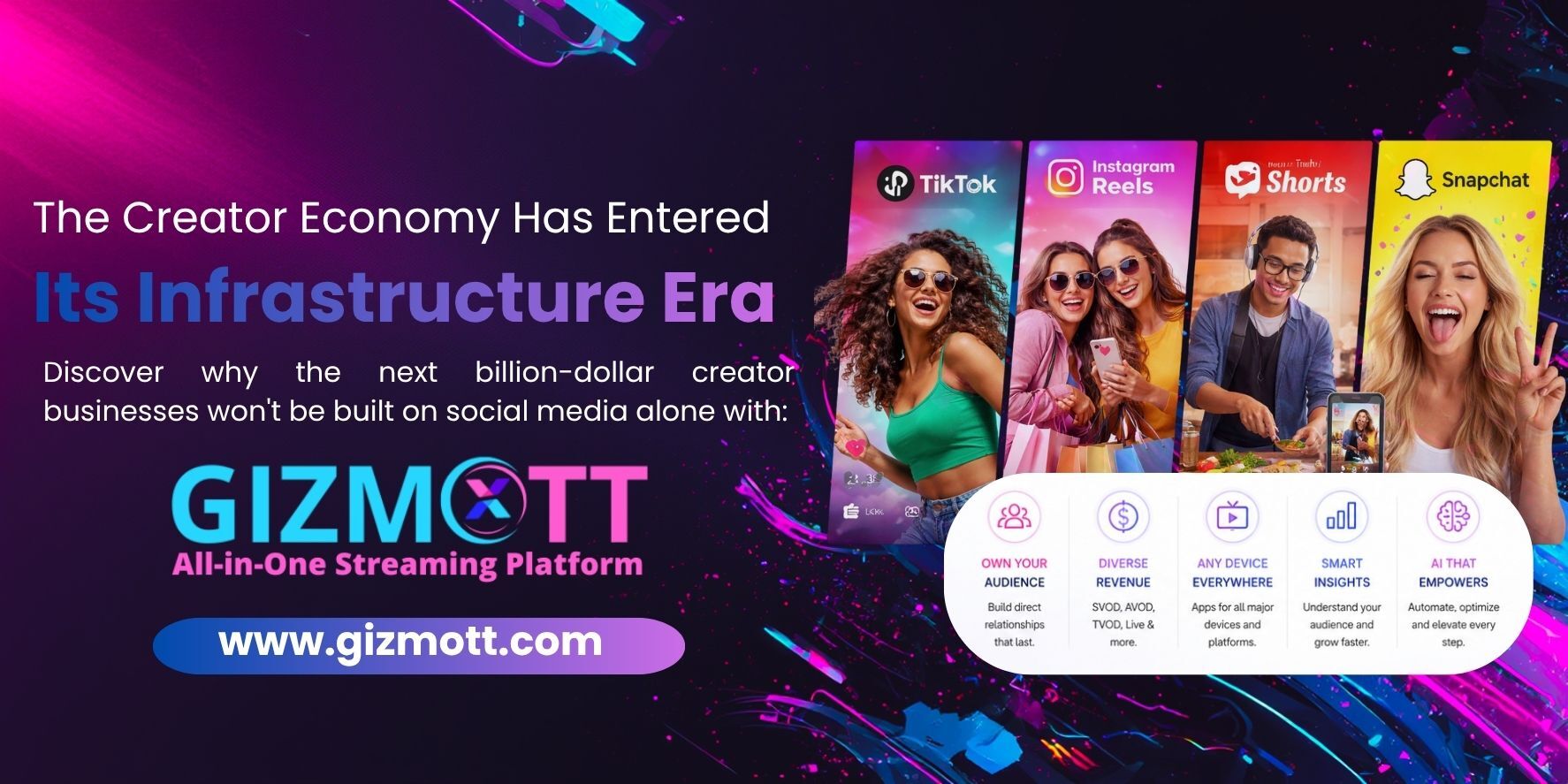
At GIZMOTT, we’ve witnessed this evolution firsthand. Creators today aren’t simply asking for an app—they’re asking how to build a business that can grow independently of changing algorithms and shifting platform policies. That’s why GIZMOTT is designed as more than an OTT platform. It enables creators, influencers, production houses, educators, and media entrepreneurs to launch branded streaming experiences with enterprise-grade capabilities. From hybrid monetization models and AI-powered discovery to vertical video support, live streaming, FAST channels, and detailed audience analytics, the platform is built to help creators transform audiences into long-term communities and recurring revenue streams. Whether the goal is to launch a niche streaming service, monetize exclusive content, expand into connected TV, or create a fully branded digital ecosystem, the focus remains the same: helping creators own their platform—not just participate in someone else’s.The Future Won’t Belong to the Loudest Creator
For years, success in the creator economy was measured by visibility. The next decade will measure something different. Ownership- Not who has the most followers – But who has the strongest community.
- Not who generates the most views – But who builds lasting customer relationships.
- Not who adapts fastest to the next algorithm – But who becomes independent of it.