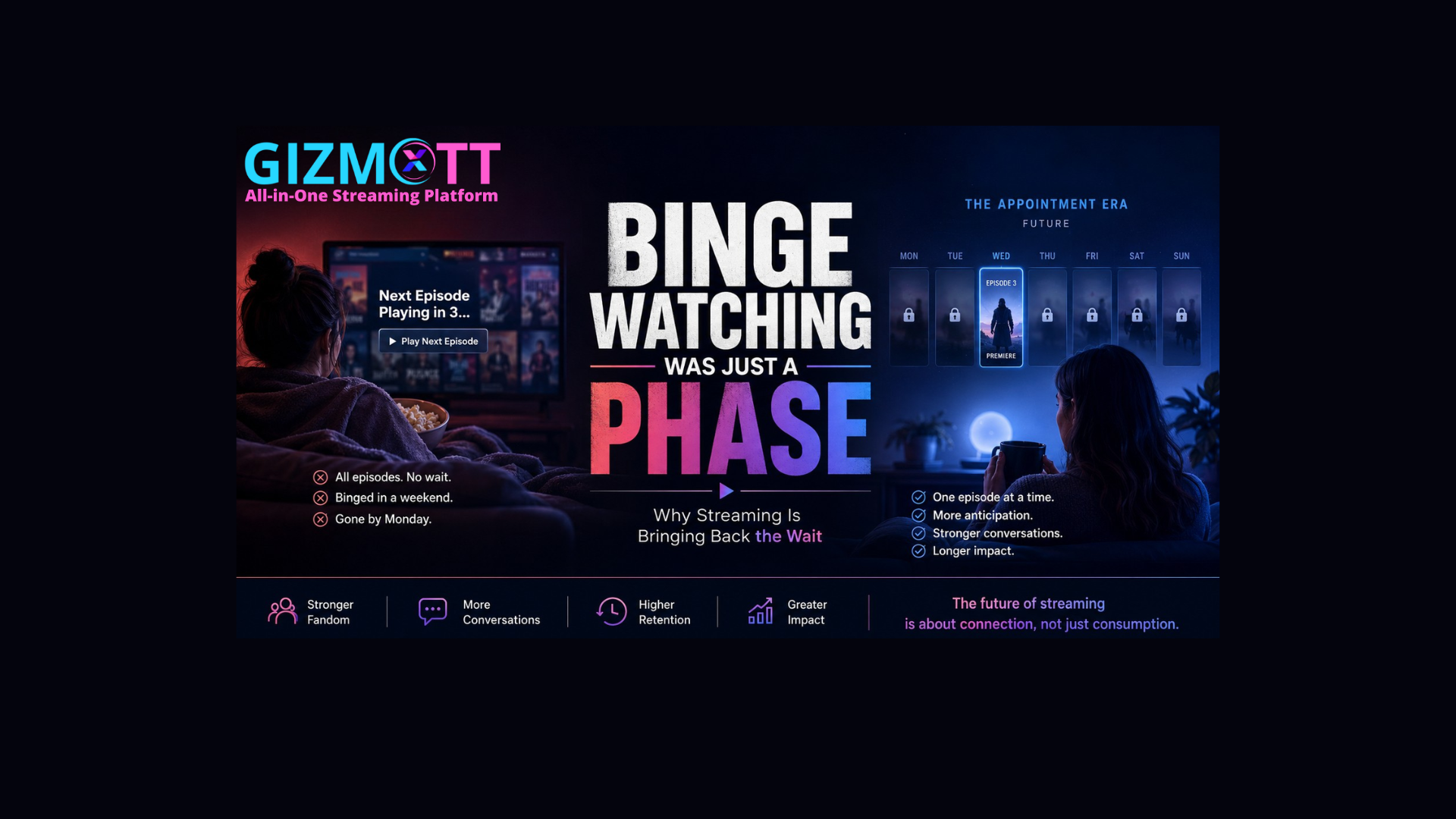
For almost a decade, binge watching felt like the ultimate promise of streaming.Television had spent generations telling audiences when to watch. Then Netflix changed the equation. Entire seasons appeared at once, the next episode started automatically, and the remote control stopped being a scheduling device and became a gateway to unlimited choice. There was no need to wait until next Sunday. There was no need to rearrange your evening around a broadcast schedule. If a show had eight episodes, you could watch eight episodes.Streaming gave audiences something traditional television never could: control.But control has a strange way of becoming exhausting when there is too much of it.Today, the streaming industry is quietly moving away from the idea that every show needs to be consumed in one weekend. Weekly episode releases, staggered seasons, hybrid release strategies and appointment viewing are returning. The binge has not disappeared, but it is no longer the only model streaming platforms consider valuable.That shift matters because the next phase of streaming may not be about giving audiences more content faster. It may be about giving audiences a reason to come back tomorrow.Recent data makes the change difficult to ignore. According to Parrot Analytics data reported by Axios, weekly releases began outnumbering binge releases among major U.S. subscription streaming services in 2021. By 2026, the industry was increasingly recognising that appointment viewing can create fandom and reduce churn.At the same time, Netflix is hardly experiencing a collapse in engagement. Its first-half 2026 report recorded more than 97 billion hours watched, its highest half-year viewing total to date. The interesting question, therefore, is not whether people have stopped watching Netflix or streaming content. They clearly have not. The question is how audiences want to experience that content.
The Streaming Industry Was Built Around the Binge
Binge watching was not simply a viewing habit. It became one of the defining features of the streaming business model.Traditional television operated around scarcity. There were a limited number of channels, a fixed schedule and a finite amount of programming available at any particular moment. Streaming reversed that model. Suddenly, audiences had libraries rather than schedules.Netflix understood the psychological appeal of this change better than almost anyone.The release of an entire season transformed television into something closer to a book. Instead of waiting a week to discover what happened next, viewers could move through the story at their own pace. A cliffhanger was no longer an interruption. It was an invitation to immediately press play.The “next episode” button became almost as important as the content itself.This created the modern binge-watching culture. Friday nights became synonymous with entire seasons. Conversations shifted from “Did you watch this week’s episode?” to “How far are you?” Spoilers became more dangerous because a person could be three hours behind rather than seven days behind.For streaming services, binge watching also solved a commercial problem. Platforms needed to convince consumers that a subscription was worth paying for. A large library, combined with a constant stream of original content, made streaming services feel substantially different from traditional television.Netflix’s own engagement reports demonstrate just how much content audiences continue to consume. The company recorded more than 95 billion hours of viewing during the first half of 2025 and another 96 billion hours during the second half.So the binge is not dead. What is changing is the assumption that audiences always want to consume everything immediately.There is also a deeper problem with the binge model. When an entire season arrives simultaneously, the cultural lifespan of that show can become remarkably short. A series launches on Friday, dominates social media over the weekend and can feel like old news by Monday.The audience may have consumed eight hours of television, but the platform may have received only a few days of conversation.That is increasingly difficult in a streaming market where customer retention, engagement, discoverability and subscriber churn matter as much as acquiring new viewers. A show that keeps people talking for eight weeks can be more strategically valuable than a show that gets watched for eight hours over one weekend.This is where the next generation of OTT platforms has a different problem to solve. It is no longer enough to simply deliver content. Platforms need to understand how content is packaged, released, discovered and monetised across different viewing behaviours.This is the direction Gizmott is built around. Rather than treating streaming as a single format or a single viewing experience, Gizmott enables media companies to build OTT platforms that can bring together traditional VOD, vertical short-form, microdramas, live content and FAST channels. The goal is not simply to give audiences more content, but to give streaming businesses more ways to keep audiences engaged.In that sense, the post-binge era is not really about replacing one release strategy with another. It is about giving platforms the flexibility to understand that different stories, audiences and moments demand different ways of watching.
Why the Weekly Episode Is Making a Comeback
The return of weekly television is not simply nostalgia for the days of broadcast TV.It is a response to the economics of streaming.A weekly release turns a television series into an event. Instead of asking viewers to consume a season, platforms can create a recurring appointment. One episode becomes a reason to return to the service, search for theories, discuss characters, watch reaction videos and participate in online conversations.The difference is particularly important in an increasingly crowded streaming market.Audiences now have Netflix, Disney+, Prime Video, Max, Apple TV+, YouTube and an expanding universe of regional streaming platforms. They also have TikTok, Instagram Reels, short-form video, podcasts, gaming and social media competing for the same finite attention.In this environment, simply having good content is no longer enough.The platform has to create a habit around the content.This is also where the definition of an OTT platform is beginning to change. Platforms such as Gizmott are being built around the idea that streaming businesses need more than video delivery. They need the infrastructure to experiment with how content is released, discovered and monetised. A single streaming service might combine traditional VOD with vertical short-form, microdramas, live events and FAST channels, depending on what its audience responds to.That is why weekly episode releases are becoming strategically interesting again. A weekly schedule extends the lifecycle of a show. It gives marketing teams more opportunities to promote it, gives audiences more opportunities to discover it and gives the internet more time to turn it into a conversation.There is also evidence that weekly viewing can generate stronger attention. TVision’s 2025 State of Streaming research found that weekly viewing of weekly-release content produced a higher attention-to-visible ratio than binge viewing of either weekly-release or binge-release content.This does not mean every show should become weekly. Some stories are inherently bingeable. Certain genres work because audiences want to remain immersed in the narrative. Crime thrillers, limited series and character-driven dramas can benefit from letting viewers move rapidly through the story.The smarter future is therefore unlikely to be “weekly versus binge.” It will be about release strategy.Streaming platforms are increasingly experimenting with hybrid formats: releasing two or three episodes initially, followed by weekly episodes; splitting a season into two parts; or combining weekly releases with occasional batches.The logic is simple. Give viewers enough content to become invested, but leave enough story unresolved to create anticipation.This is particularly powerful for franchises.When a new season arrives, viewers are not only consuming the new episodes. They are rediscovering previous seasons, revisiting characters and returning to online communities built around the show. Netflix’s 2026 engagement report showed exactly this effect: the return of Bridgerton Season 4 nearly tripled viewing of earlier seasons compared with the previous reporting period.That is the difference between content consumption and content ecosystems. A successful streaming franchise does not simply produce viewing hours. It creates recurring behaviour.
The Real Shift Is From Consumption to Participation
The most interesting change in streaming may therefore have little to do with episode length or release schedules.It is about participation.The old streaming model encouraged audiences to consume. The emerging model encourages them to participate.Consider what happens when an episode is released weekly. Within hours, social media fills with reactions. YouTube creators publish breakdowns. Reddit communities debate theories. TikTok creators produce edits. Podcasts analyse character decisions. Fans speculate about what happens next.The episode becomes raw material for an entire digital ecosystem.A binge release compresses much of that activity into a shorter period. A weekly release stretches it across weeks.This matters even more because short-form video has changed the way audiences discover long-form entertainment.People increasingly encounter shows through clips, memes, reactions and recommendations before they ever open a streaming application. Discovery is no longer confined to the platform where the content lives.The irony is that short-form video may actually be helping long-form television.A TikTok clip can introduce a character. An Instagram Reel can reveal a dramatic scene. A YouTube creator can explain a theory. The viewer then moves to a streaming service to watch the full story.At the same time, microdramas are taking this logic even further. Short, vertically shot episodes designed for mobile consumption are becoming a rapidly expanding entertainment category. Reuters reported in August 2026 that the U.S. microdrama market had already reached approximately $1.5 billion and was attracting increasing attention from major media companies.This suggests that the future of streaming is not necessarily one giant format replacing another.It is fragmentation.Audiences may watch a 45-second vertical episode during a commute, a 50-minute prestige drama at night, a YouTube creator on their television and a FAST channel while cooking dinner.For OTT businesses, this fragmentation creates a technology problem as much as a content problem. The infrastructure needs to support different formats, devices, monetisation models and viewing behaviours without forcing every piece of content into the same mould. This is increasingly the direction platforms such as Gizmottare taking: one OTT infrastructure that can deliver long-form video, 9:16 vertical content, microdramas, podcasts, live events and FAST channels through a unified content ecosystem.The idea of a single “streaming audience” is becoming increasingly outdated. People are developing different viewing behaviours for different moments.This is where the concept of binge watching being “just a phase” becomes more interesting.Perhaps the binge was never the destination of streaming. Perhaps it was simply one stage in the evolution of on-demand entertainment. The first stage was about breaking free from television schedules. The second was about giving audiences unlimited libraries. The next stage is about understanding context: what people want to watch, when they want to watch it, how much they want to watch and what will make them return. That changes how streaming platforms think about content.The winning platform may not be the one with the largest library. It may be the one that understands how to package, distribute and monetise content across different viewing behaviours. That means content strategy, release strategy, audience intelligence, recommendation engines, advertising technology and product design increasingly need to work together.For media companies, this creates a new challenge.They can no longer ask only, “What should we produce?”They also need to ask, “How should this story be released?”Should it be a binge? A weekly series? A hybrid release? A short-form companion? A FAST channel? A vertical microdrama? A social-first campaign that drives viewers toward an OTT platform?The answer may be different for every piece of content.
Conclusion: The Future of Streaming May Be About Making People Wait
Binge watching changed television forever.It proved that audiences did not need traditional schedules. It demonstrated the power of on-demand entertainment and helped streaming become one of the dominant forces in the global media industry. But the industry is now discovering something it temporarily forgot. Waiting can create value.A weekly episode creates anticipation. A cliffhanger creates conversation. A release schedule creates habit. A shared viewing moment creates community. The future of streaming is therefore unlikely to be a complete return to traditional television. Audiences will not willingly give up the freedom that streaming gave them.Instead, the industry is moving toward something more flexible: a world where binge watching, weekly releases, short-form video, microdramas, FAST channels, live programming and personalised recommendations coexist. The real competitive advantage will come from knowing when to use each one.This is why the next generation of OTT platforms will need to think beyond the traditional streaming app. At Gizmott, the question is not simply how to put another streaming service on a phone or smart TV. It is how to give media companies the infrastructure to experiment with different formats, release strategies, audience experiences and revenue models from the same platform.Binge watching may have defined the first era of streaming.But the next era could be defined by something much older.The reason people keep coming back is not always that the next episode is available.Sometimes, it is that it isn’t.And in an industry built on instant access, the ability to make people wait may become one of the most valuable features of all.